The Weave Library
Making psychiatry easier to reach.
Field guides and references written in practice, for the people who do the work and the people living through it. Most are free to read and download.
 The flagship
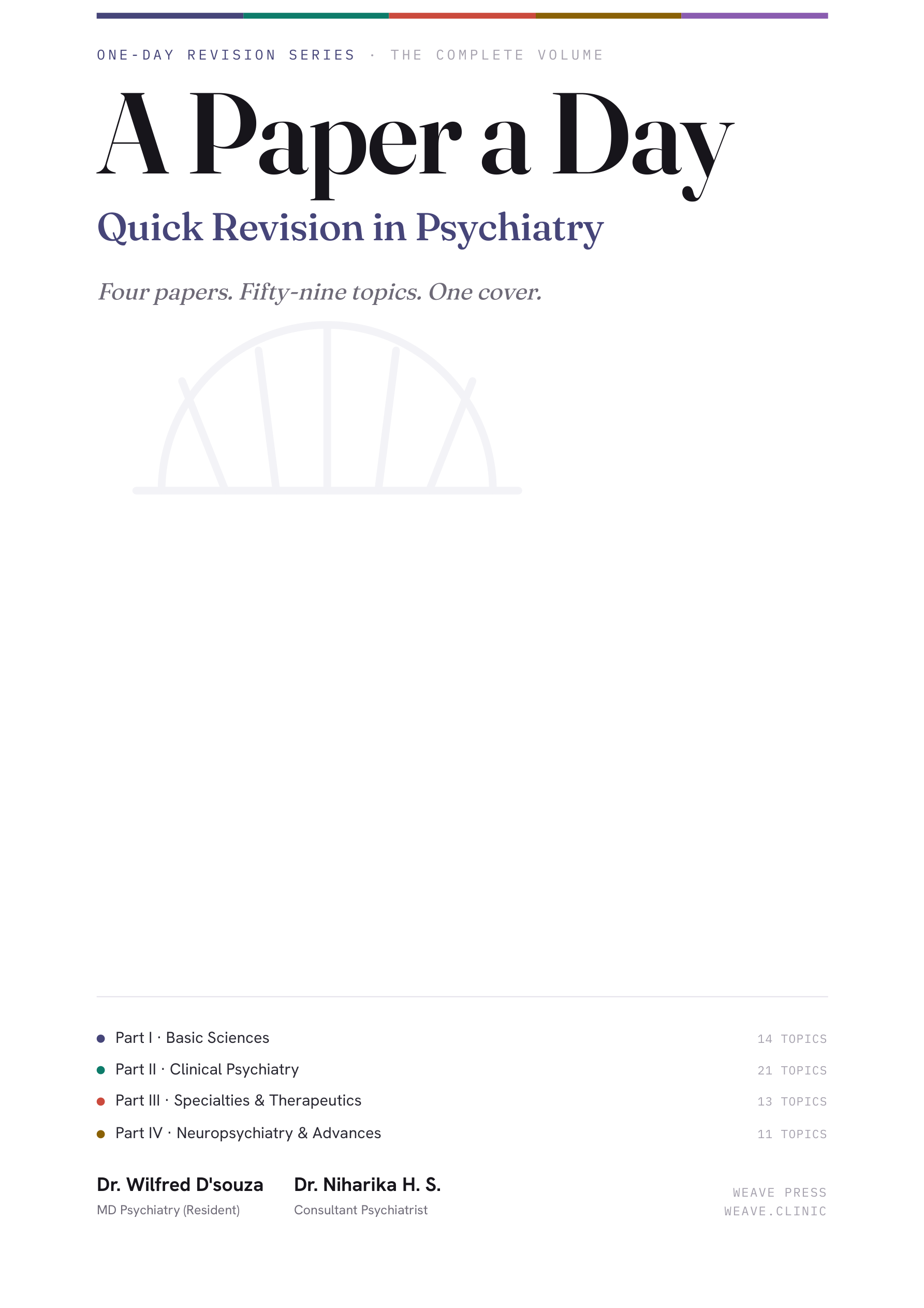
A Paper a Day
Four papers. Fifty-nine topics. One day.
The whole MD psychiatry written exam in one volume. 533 pages, a five-colour memory code, clickable contents and indexes throughout. Free to read.
The flagship
A Paper a Day
Four papers. Fifty-nine topics. One day.
The whole MD psychiatry written exam in one volume. 533 pages, a five-colour memory code, clickable contents and indexes throughout. Free to read.
 The exam sprint
Weave Sprint
Forty study days. Four theory papers.
Forty day-wise study guides and four illustrated theory papers for MD psychiatry revision. Read online with page-by-page search, free to download, no sign-up.
The exam sprint
Weave Sprint
Forty study days. Four theory papers.
Forty day-wise study guides and four illustrated theory papers for MD psychiatry revision. Read online with page-by-page search, free to download, no sign-up.
For Clinicians · Adult Psychiatry
The History‑Taking Compendium
Every question worth asking, in the order a good clinician asks it.
A complete reference for the psychiatric history and mental state examination, built to the NIMHANS proforma and aligned to the RGUHS MD exit exam. Four hundred pages that move from the opening question to the formulation, with the clinical reasoning that holds them together. Written to pass the exam, and to stay on your desk for the decade of practice after it.

For Clinicians · Diagnostic Coding
Adopting the ICD-11 from ICD-10
A Resident's Coding Guide
Three manuals, one spine: read across from any code and see exactly what changed.
A coding concordance that sets ICD-10, ICD-11 and DSM-5-TR side by side, in ICD-10 (F-block) order, so a clinician fluent in one can read straight across to the others. Every F-block worked card by card, near-verbatim to the source texts, with a coding companion for comorbidities, post-coordination and the codes beyond the mental chapter, and clickable alphabetical and crosswalk indices. Built for the resident sitting an exit exam in one classification while training in another.

For Clinicians · Treatment Guidelines
The Resident's Atlas of Psychiatric Prescribing
Every major treatment guideline, set side by side. An India-first comparison.
Where the guidelines agree, where they diverge, and what is actually prescribable in India.
Twenty-one disorder chapters and ten cross-cutting therapeutics that lay the world's treatment guidelines side by side, by disorder and by phase, harmonising a dozen grading languages onto one five-point key with every body's own native grade kept beneath it. A drug atlas then runs from the drug outward, by class and by condition, and an India-first lens (DCGI approval, brand availability, NDPS scheduling and cost) runs throughout. Built for the resident who wants to see, at a glance, where the agreement is firmest and where judgement is needed.

For Clinicians · Descriptive Psychopathology
Psychopathology for Residents
The descriptive tradition, in twelve chapters
The phenomenology set out the way a mental state is actually read, from consciousness to personality.
A companion for descriptive psychopathology, compiled across postgraduate training and drawn from the classical tradition of Fish, Sims, and Jaspers. Twelve chapters move in the order a mental state is examined: consciousness, perception, thought, speech, emotion, the self, memory, motor behaviour, and personality, each with its disorders, the history that shaped the concept, and the exam points that get tested. Built for quick revision on a clinical posting and the night before a viva.

For Clinicians · Psychotherapy
Weaving the Self
Volume One: Foundations. A clinician's manual of integrative psychotherapy.
The interview and formulation that come before any modality is chosen.
The foundation volume of the Weave therapy system: how to conduct a full life-course interview, how to listen for identity, attachment and schema seeds inside ordinary answers, and how to build a formulation that moves from broad to specific without losing the person. It closes with the complete foundation interview, working maps, prompts, and field-ready clinical forms. Written for therapists and residents who want their first sessions to do real work.

For Clinicians · Psychotherapy
Weaving the Self
Volume Two: Modalities, Cases, Appendices.
Eight modality guides, one integration stance, and twenty-two worked cases.
The working volume of the Weave therapy system. Eight modality guides with explicit clinical lenses: schema therapy, CBT, ACT, metacognitive therapy, DBT, emotion-focused therapy, motivational interviewing, and psychodynamic foundations. An integration section teaches choosing and sequencing across them, twenty-two composite cases show the decisions in motion, and appendices hold the frame, the therapist, rupture, and endings. A manual for choosing, not merely collecting.

For Clinicians · Psychotherapy
Basics of Psychotherapy
A working foundation for the consulting room.
What psychotherapy is, why it works, and whether it works.
The book to read before any modality. What the word covers, how the named therapies relate to one another, and the healing that happens outside technique altogether: spontaneous remission, the placebo, the alliance, suggestion, the group. Then the variables that shape every case, the boundary with counselling, the common core every therapy shares, and an honest chapter on whether any of it works. Built on Wolberg, restructured for teaching, and corrected where the classic account has been overtaken.

For Clinicians · Psychotherapy
Therapist's Guide to Case Conceptualisation
A practice standard: one formulation grammar, eight modality lenses.
A formulation should stay alive: written, shared, and revised as the work moves.
A compact practice standard for writing case conceptualisations that actually get used. A ten-step master guide builds the formulation, eight modality lenses show how the behavioural, cognitive, dialectical, schema, interpersonal, motivational, acceptance and emotion-focused traditions each read the same person, and a quick-reference matrix with a blank master template makes the standard reusable across a practice. It ends with the patient's own plain-language version of the formulation.

Aporia · Clinical Dilemmas
The Aporia series
Short essays on the decisions that fork a patient's life. All twelve are free: read online or take the PDF.

The Weight of the Wallet
Capacity, debt and suicide risk, money addictions: the wallet as a clinical variable.

The Way They Walk In
Drug-induced, functional, catatonic, cerebellar: reading the walk into the room.

When Words Fail
Diagnostic overshadowing: reading behaviour as communication when words fail.

The Restless and the Rigid
Dystonia, akathisia, parkinsonism, tardive: telling the movement syndromes apart.

After the First Failure
Switch, augment, clozapine, ECT: the forks after the first drug fails.

The Shape of the Dose
The same molecule, four routes: when the formulation is the treatment decision.

The Gate and the Name
Affirmation over gatekeeping: the psychiatrist's role when the law moved first.

Heat and Iron
The febrile, rigid patient: four syndromes, contradictory treatments, one fork.

The Quiet That Speaks
Charles Bonnet, deafferentation, or a first break? The distinction changes everything.

Four Codes, One Question
One delusion, four codes: the call that shapes a prognosis and a record.

Months Between Pills
The case for moving long-acting injectables up the algorithm.

Two Roads, One Circuit
Bipolar or drug-induced? The fork that decides ten years of treatment.
For Clinicians · Dimensional Psychiatry
Reading the Patient
A Field Guide to Dimensional Psychiatry
Read the patient the way the field actually thinks now, not the way the textbook still teaches.
A teaching text, not a reference book: the lens you put on before you reach for the checklist. Indian training still defaults to the DSM-5 categories; academic psychiatry has moved past them. This book teaches the dimensional reading in plain language, six spectra, a general factor of psychopathology, an eight-domain mental state examination, all held together by Bayesian reasoning, then carries it into three rooms: the casualty at two in the morning, the Wednesday-morning clinic, the post-operative surgical ward.

For Residents & Trainees
Everything for your training, in one place
Free deep-study modules, postgraduate exam notes, and the full thirteen-volume psychotherapy curriculum, all below. The searchable exam study guides have their own home at Study.
For Clinicians · Deep-study modules
Weave Assimilate
Eighteen focused modules that go deep on the topics worth slowing down for. Free; you fill the form once.


For Clinicians · Postgraduate exams
Weave Study Guides
The full study-guide set across all four papers. Free, one click, no form. The searchable web edition lives at /study.
For Clinicians · Psychotherapy curriculum
Weave Psychotherapy
The thirteen-volume psychotherapy curriculum, from foundations to the question bank. Free; you fill the form once.
The Weave Family Library
Free, plain-language books for living with a condition, and for the people who live it with you. Written without jargon and without labels, in English, Hindi, and Marathi. The first guide, on the adult ADHD mind, is ready to read now.
Open the Family Library