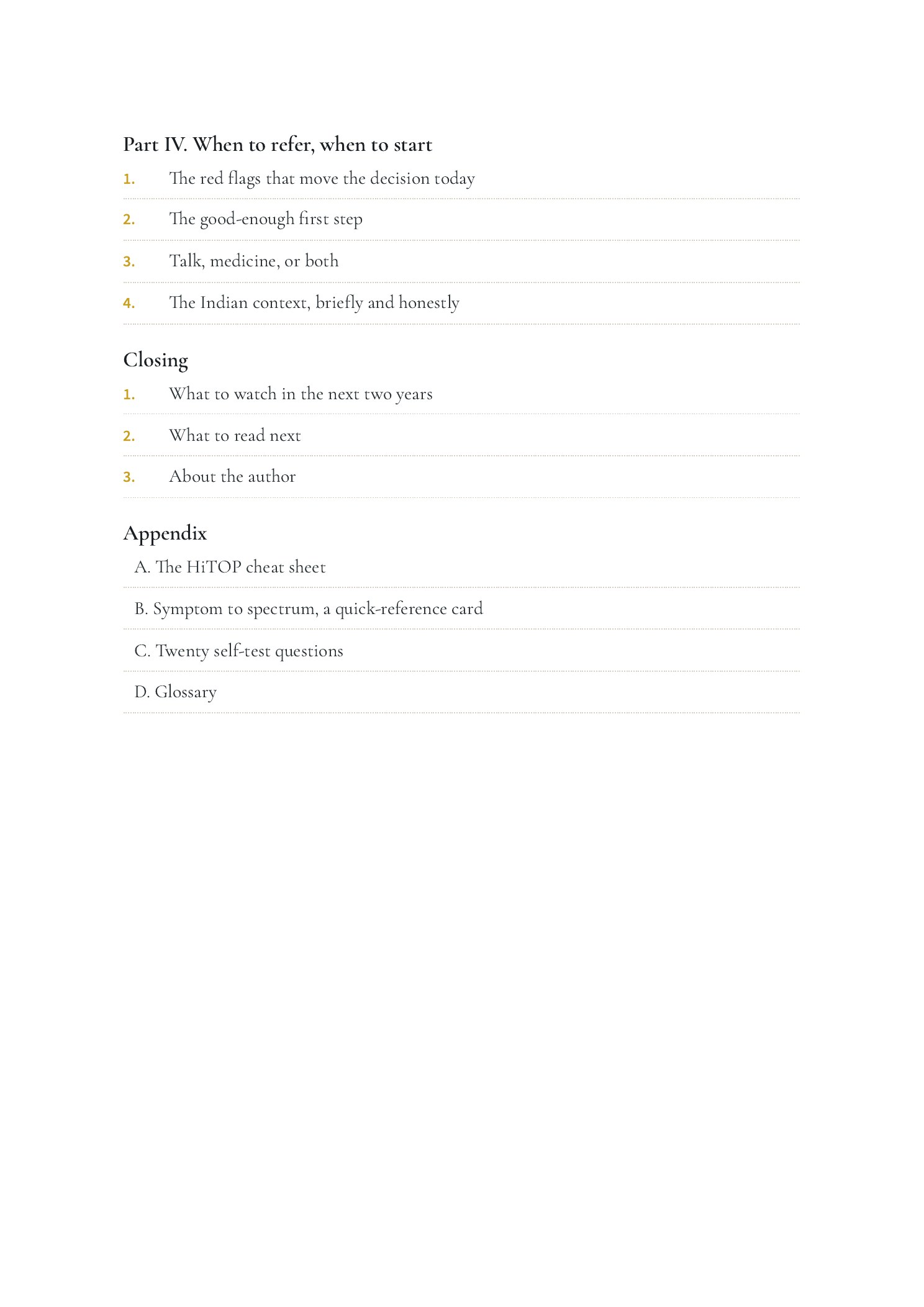
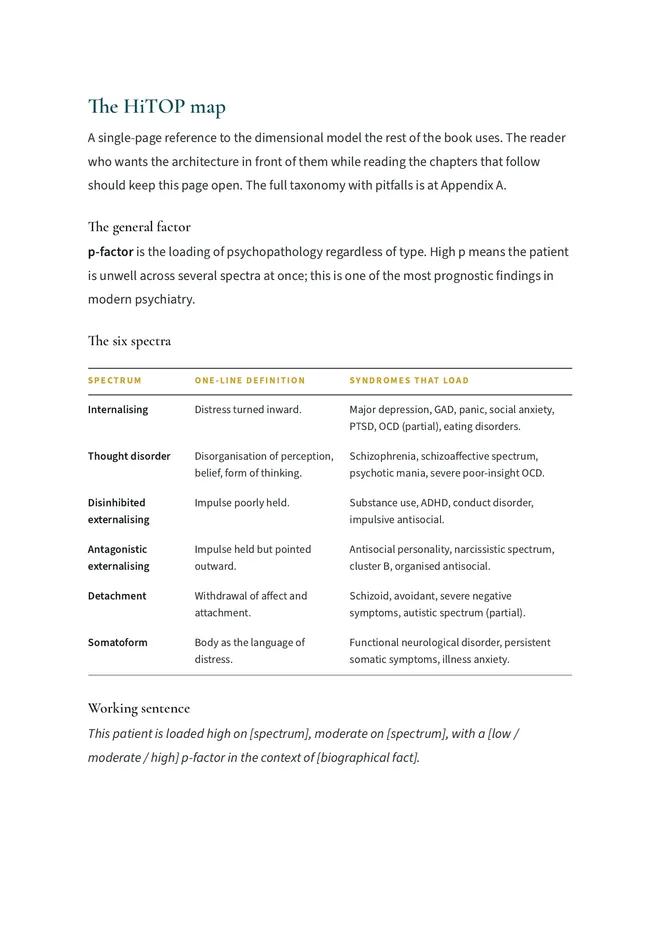
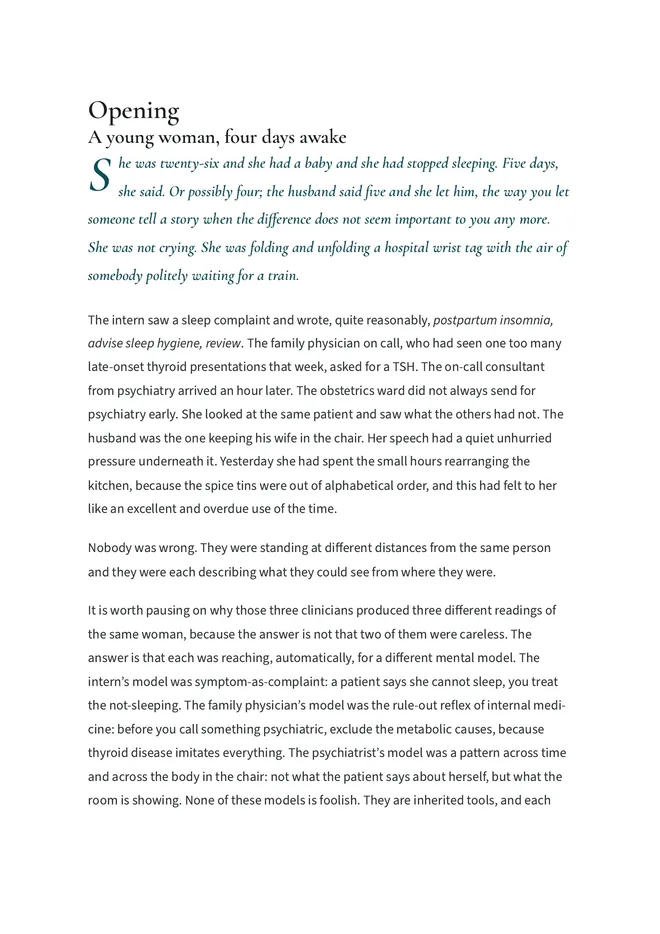
A few pages from inside
Click any page to download the 12-page sample as a PDF.
What this is
A teaching text, not a reference book. The lens you put on before you reach for the checklist.
Most clinical teaching in India still defaults to the DSM-5. Academic psychiatry has moved on. This book teaches you to read a patient the way the field actually thinks now: six spectra, a general factor of psychopathology, an eight-domain mental state examination, all held together by Bayesian reasoning. Three composite case scenes show the same eight-domain reading applied in three rooms: the casualty at two in the morning, the Wednesday-morning OPD, the post-operative surgical ward.
Written for the MBBS intern, the family physician, the emergency registrar, the senior resident before viva, the MPhil clinical psychology student. The clinician with a stethoscope is who I am writing for first.
Inside
- A young woman, four days awake
- What this book is, and what it is not
- Psychiatry is the medicine of inference under uncertainty
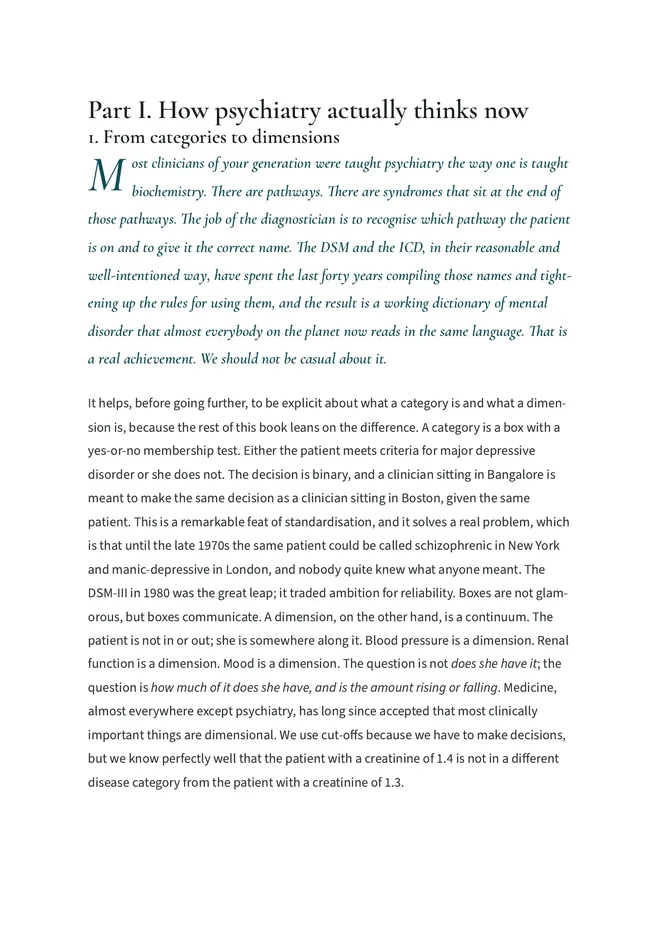
- From categories to dimensions
- HiTOP in plain English
- Computational psychiatry, briefly
- Network thinking
- Illuminative psychiatry
- Stance
- Appearance and behaviour
- Speech
- Mood and affect
- Thought, form and content
- Perception
- Cognition
- Insight and judgement
- The casualty at two in the morning
- The Wednesday-morning clinic
- The surgical ward, post-operative day three
- The red flags that move the decision today
- The good-enough first step
- Talk, medicine, or both
- The Indian context, briefly and honestly
- What to watch in the next two years
- What to read next
- About the author
- Appendix A: The HiTOP cheat sheet
- Appendix B: Symptom to spectrum, a quick-reference card
- Appendix C: Twenty self-test questions
- Appendix D: Glossary
What you get
- The full PDF: instant download the moment your payment goes through.
- Watermarked. Licensed for personal use; please do not share or upload.
- Lifetime access. Future minor revisions sent to you free.
- Mobile-readable. Sized for phone screens, also prints clean on A4.
- Trainee or in financial difficulty? Email us, no proof required.
Digital purchases are non-refundable once the file has been sent. If anything is wrong with the file or the delivery, write to us; we will fix it or refund you.
Why this one is paid
We have been quietly putting things out for the last few months: the Study Guide, Assimilate, the Psychotherapy Notes, the History-Taking Compendium. All free. All staying free.
To keep doing this work properly, a few things have to be paid. This is the first one. The pitch is simple: buying it gets you a sharper clinician, and it keeps the rest free for everyone else. One transaction, two outcomes.
If it helps you, that is the point. If it also keeps the free things free, that is the other point.