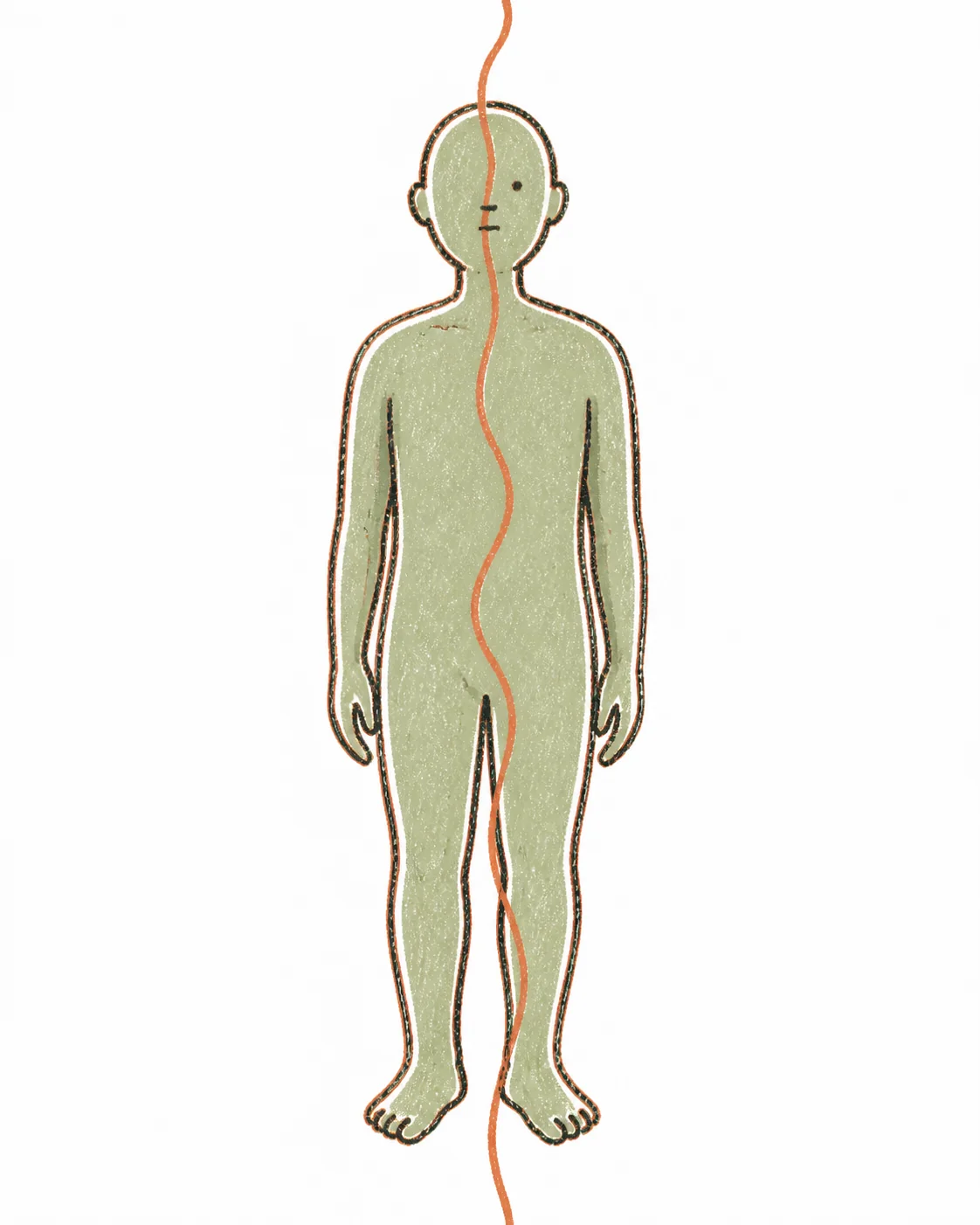
The headaches that won't stop. The back pain that no painkiller touches. The stomach that's been a mess for years. You've been to five doctors. Maybe ten. Everything comes back normal. And you're tired of being told there's nothing wrong.
Your pain is real. It's not made up. It's not drama. It's not "all in your head." Something is genuinely happening in your body. And there may be a reason no one has found the cause yet, because they've been looking in the wrong place.
When Your Body Speaks What Your Mind Can't
When people say "stress causes pain," it sounds like another way of saying "it's not real." That's not what we mean.
The same pathways
Pain and emotion share the same neural pathways. The anterior cingulate cortex, the prefrontal cortex, the amygdala, these brain areas process both physical injury and emotional distress. This isn't a metaphor. It's neuroscience.
The same signal
When you experience ongoing stress, grief, conflict, or trauma, your brain processes that distress through the same circuits it uses for physical pain. Your nervous system doesn't distinguish between a broken bone and a broken heart. Both register as pain. Both are real.
Central sensitisation is what happens when your nervous system gets stuck in high alert. Imagine a smoke alarm that starts going off every time you make toast. The alarm isn't broken, it's been turned up too high. Your nervous system can do the same thing.
The stress-pain loop
This is biology, not imagination. Your body is doing exactly what it was designed to do under threat. The problem is that the threat never stopped.
Does This Sound Familiar?
- Headaches that don't respond to painkillers. You've tried paracetamol, ibuprofen, triptans. The headache comes back the next day, or it never fully leaves.
- Back pain or neck pain with no structural cause. The MRI shows "mild degenerative changes", the kind every adult has. Nothing that explains the level of pain you're living with.
- Stomach problems that won't settle. Bloating, cramps, nausea, loose motions, constipation, sometimes all in the same week. You've been told it's IBS. Research shows IBS is strongly linked to anxiety, depression, and trauma.
- Chest tightness or palpitations. The ECG was normal. The echo was normal. But your chest still feels like someone is sitting on it. That tightness is real, it's your nervous system, not your heart.
- Fatigue that sleep doesn't fix. You sleep eight hours and wake up exhausted. The tiredness isn't coming from lack of sleep. It's coming from a nervous system that never switches off.
- Numbness, tingling, or dizziness. Neurologist says it's not MS. Not a stroke. The pins and needles are still there.
The pattern that ties it all together: your pain gets worse when you're stressed, and no single specialist can explain the whole picture.
Why Women Carry This More
Chronic pain with no clear medical cause affects women far more than men. This isn't coincidence. It's the result of biology, socialisation, and a medical system that still doesn't listen to women properly.
The Biology
Oestrogen affects pain sensitivity. Hormonal fluctuations across the menstrual cycle, pregnancy, and perimenopause can change how your nervous system processes pain. Most pain research was done on men, so this was ignored for decades.
The Socialisation
Many women, especially in India, are taught to suppress anger, frustration, and their own needs. When emotions have no exit through words, the body becomes the only language left. The pain is the expression of everything that couldn't be said.
The Medical System
Research shows women wait longer to be seen for pain, are more likely to have their pain called "emotional," and receive less adequate pain relief compared to men with the same complaints.
The Indian Context
Women in Indian families are often the default caretakers. Cook, clean, manage the house, manage everyone's emotions. Their own needs come last, often don't come at all. Eventually, the body refuses to stay silent.
Her back hurts but she still makes rotis for fifteen people. Her head is splitting but she still manages the in-laws' medication schedule. Her body is saying what her world doesn't allow her to say.
The Connection Most Doctors Miss
Here's something that changes everything once you understand it: in many cultures, especially across South Asia, depression doesn't look like sadness. It looks like body pain.
Studies from Indian primary care settings show that up to 97% of people with common mental health concerns present with physical complaints first. Not because they're hiding their emotions, because the body is genuinely where the distress lives for them.
How the Diagnostic Miss Happens
What it costs
Years pass. Lakhs spent. Dozens of appointments.
What nobody asks
About your sleep, your stress, your relationships, your childhood.
What was true all along
The pain was real the whole time. The cause was just in a different department.
Cultural Idioms of Distress
In India, emotional distress often gets expressed through the body in culturally specific ways:
These aren't imaginary. They're real physical experiences. They're also, often, the body's way of expressing emotional pain in a culture where saying "I feel hopeless" or "I'm angry at my family" isn't safe.
When to Consider That Pain Might Be Connected to Emotions
Not all chronic pain has an emotional component. Some pain is purely structural.
Consider the Possibility If
- All medical tests are normal but the pain persists
- Pain moves around your body, headache this month, back pain the next
- Pain worsens with stress and improves when you're relaxed or on holiday
- There's a history of trauma, loss, or chronic stress
- Multiple "functional" conditions coexist, IBS plus headaches plus back pain plus fatigue
- Pain doesn't respond to standard painkillers, physiotherapy, or conventional approaches
- You've seen specialist after specialist and no one can find the cause
If three or more of these are true for you, there's a good chance your nervous system is involved in a way that standard medical workup won't detect.
That doesn't mean the pain is fake. It means the solution sits somewhere other than where everyone has been looking, and that somewhere is usually a consultation rather than another scan.
If you are looking for one in the city, our page for a psychiatrist in Mumbai sets out how we work.
What Actually Helps
Recognition Comes First
Sometimes the most powerful moment is when someone finally says: "Your pain is real. And it's connected to what you've been carrying emotionally." Not one or the other. Both.
Research shows that when people understand how their nervous system creates and maintains pain, their pain levels can actually decrease. Just understanding what's happening gives the brain new information to work with.
Psychotherapy
CBT for chronic pain
Helps you understand the thoughts and behaviours that keep the pain cycle going. Catastrophising, avoidance and hypervigilance all amplify pain. CBT helps you interrupt them.
Schema Therapy
Decades of suppressed needs, unprocessed grief, or a life built around pleasing others: those are schemas, deep patterns that started in childhood. Your body may be the only part of you that has been honest about what they cost.
Somatic approaches
Work directly with the body. They help you notice physical sensations without fear, release tension held for years, and rebuild a sense of safety in your own body.
Medication That Targets Both Pain and Mood
SNRIs like duloxetine
Work on both serotonin and norepinephrine, chemicals involved in mood AND pain processing. A Cochrane review found duloxetine has strong evidence for reducing chronic pain intensity. It is not a painkiller in the traditional sense; it calms the pathways that process pain signals.
Tricyclics like amitriptyline
Used for chronic pain for decades, especially at low doses, and particularly helpful for neuropathic pain, headaches and IBS. These medicines are not about "proving it's psychological." They work because pain and mood share the same brain chemistry.
Movement That Heals
Yoga (the gentle, breath-focused kind), walking (thirty minutes, most days), and tai chi all have strong evidence for chronic pain. The key: gentle, gradual, and never punishing. Your body has been in survival mode. It needs coaxing, not forcing.
Mindfulness-Based Stress Reduction (MBSR)
Originally developed specifically for chronic pain. It doesn't ask you to make the pain disappear, it changes your relationship with pain. The evidence is strong for back pain, fibromyalgia, and pain with coexisting depression or anxiety.
What Does Not Help
- Being told "just relax"
- Being told "it's all in your head"
- Being dismissed or disbelieved
- More tests when the pattern clearly points to nervous system involvement
- Stronger painkillers (which can actually worsen central sensitisation over time)
- Being made to feel that your pain is your fault
What We Do Differently
At Weave, we don't separate mind from body. We don't make you choose between "real pain" and "emotional pain", because that distinction is false.
We listen to the whole story
Not just the pain, the life around it. The stress. The relationships. The things you've been carrying. The things nobody asked about.
We work where the two meet
Medication that targets shared pain-mood pathways, therapy that addresses the patterns underneath, and practical strategies that help your nervous system come out of high alert.
We won't dismiss you. We won't order another round of tests to prove nothing is wrong. We'll start from the assumption that everything you're experiencing is real, and we'll look in the places no one else has looked.
Frequently Asked Questions
Does "psychological" pain mean the pain isn't real?
No, pain is always real; the question is what generates it. A psychological component means the nervous system produces genuine pain signals, as real as any pain. The solution differs: not another scan or stronger painkiller, but helping the nervous system out of the pattern.
I've been told it's IBS / fibromyalgia / tension headaches. Is that the same thing?
They are all "functional" conditions: real, diagnosable conditions where the nervous system is the driver. They frequently coexist, share underlying mechanisms, and often respond to the same approaches. One diagnosis does not rule out the others.
Will a psychiatrist think I'm making it up?
A good psychiatrist starts from the opposite assumption: that what you are experiencing is real. The task is to understand it better. We take somatic presentations seriously. This is one of the most underserved areas in Indian psychiatry, and one we are equipped for.
How long might care take?
It varies. Some people notice significant improvement within a few months. When pain is connected to longstanding patterns or trauma, it takes longer. The goal is not only pain reduction; it is a different relationship between mind, body and what you carry.
Do I need to stop seeing my other doctors?
No, we work alongside other medical care, not instead of it. If there are investigations that are genuinely warranted, we will support that. What we add is the part usually missing: your nervous system and the life around the pain.