Feeling like it is too much? Crisis help Open the crisis card →

The Weave Family Library

One page overviews for mental health

Free, plain-language single pages you can read in about a minute. If one sounds like you, the full book is one tap away.

26 so far, and growing. The full library covers every condition in English, Hindi, Hinglish, Marathi and Kannada. Browse the whole shelf →

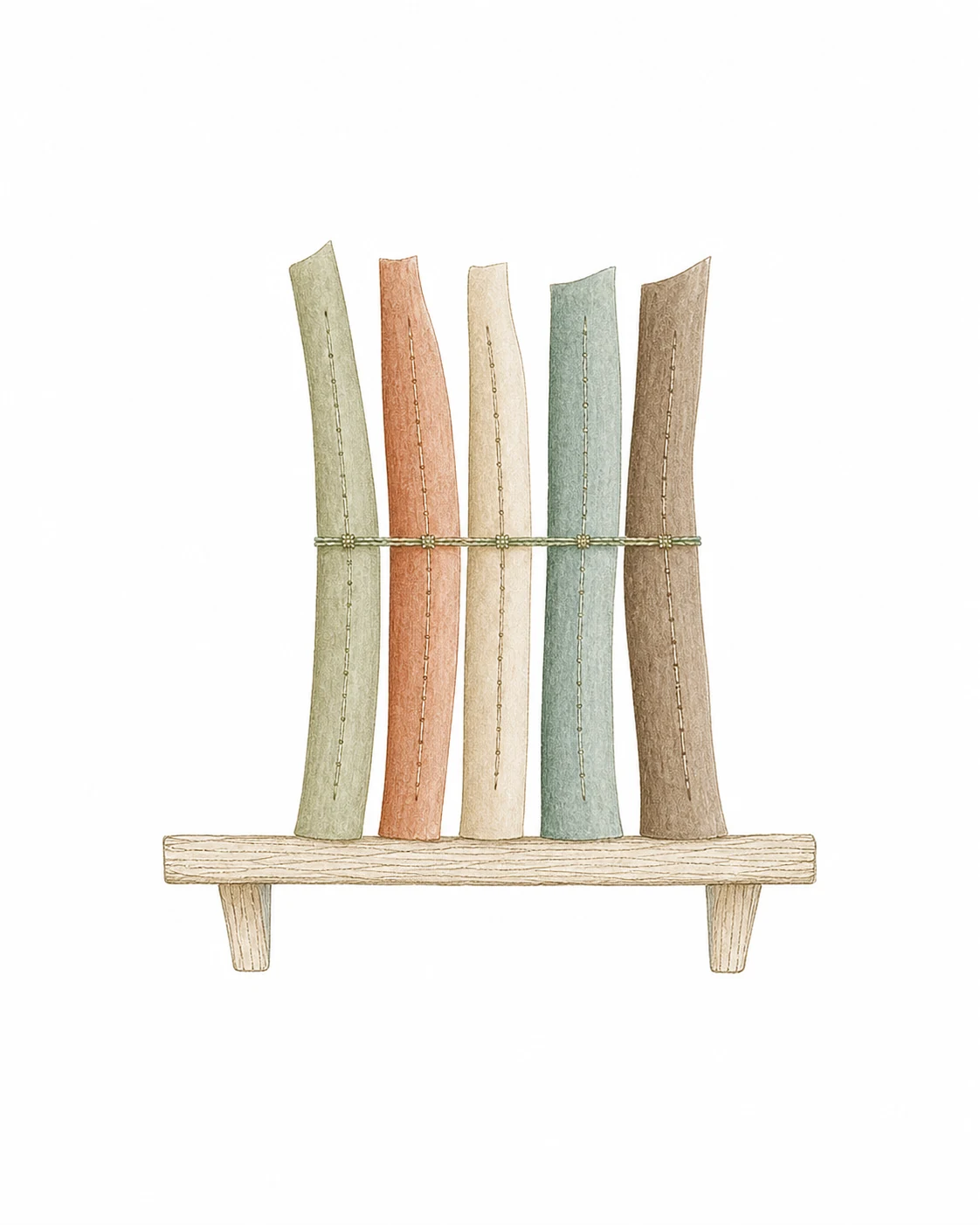
Hand-drawn single sheets of paper standing on a wooden shelf

For everyone

When should we ask for help?

You do not need a diagnosis to ask.

Read as text

WEAVE FAMILY, ONE PAGE

WHEN SHOULD WE ASK FOR HELP?

You do not need a diagnosis to ask for help.

'I kept waiting for it to pass.'

If sleep, work, relationships or self-care are suffering, you do not have to figure it out alone.

Signs: Thoughts or feelings feel harder to manage. Daily life is suffering. Behaviour, speech or energy has changed. Someone may not be safe.

1. NOTICE what changed. 2. TELL someone you trust. 3. BOOK A VISIT if daily life is affected. 4. EMERGENCY CARE if someone is unsafe.

'I have not been myself. Can you help me take the next step?'

Write down what changed, when it started and what is hardest now.

Book a visit. If you do not know where to start, call Tele-MANAS.

FAMILY: Listen. Stay calm. Help them reach care. Do not promise secrecy if someone is unsafe.

GET EMERGENCY HELP NOW: Immediate danger or a suicide attempt; a suicide plan with access to dangerous items; severe confusion or violent behaviour; or if the person cannot be kept safe. Stay with them if safe. Call 112 or go to the nearest emergency department. For 24-hour mental-health support, call Tele-MANAS 14416 / 1800-89-14416.

Dr. Wilfred D'souza, Dr. Niharika Reddy. weave.clinic/family
For everyone

Mental-health medicines

What to expect, and what to ask.

Read as text

WEAVE FAMILY, ONE PAGE

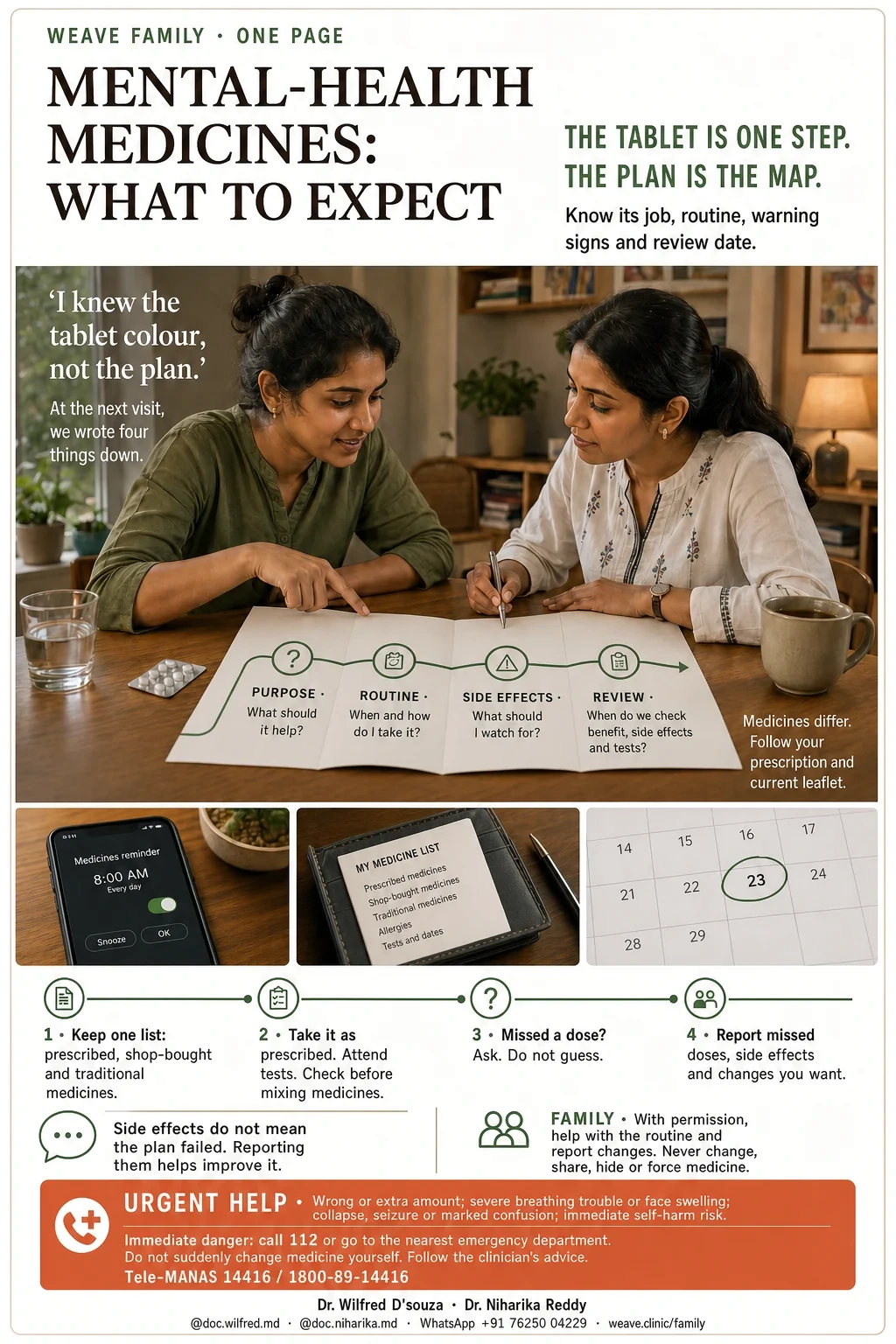
MENTAL-HEALTH MEDICINES: WHAT TO EXPECT

THE TABLET IS ONE STEP. THE PLAN IS THE MAP.

Know its job, routine, warning signs and review date.

'I knew the tablet colour, not the plan.' At the next visit, we wrote four things down.

PURPOSE: What should it help? ROUTINE: When and how do I take it? SIDE EFFECTS: What should I watch for? REVIEW: When do we check benefit, side effects and tests?

Medicines differ. Follow your prescription and current leaflet.

1. Keep one list: prescribed, shop-bought and traditional medicines.

2. Take it as prescribed. Attend tests. Check before mixing medicines.

3. Missed a dose? Ask. Do not guess.

4. Report missed doses, side effects and changes you want.

Side effects do not mean the plan failed. Reporting them helps improve it.

FAMILY: With permission, help with the routine and report changes. Never change, share, hide or force medicine.

URGENT HELP: Wrong or extra amount; severe breathing trouble or face swelling; collapse, seizure or marked confusion; immediate self-harm risk. Immediate danger: call 112 or go to the nearest emergency department. Do not suddenly change medicine yourself. Follow the clinician's advice. Tele-MANAS 14416 / 1800-89-14416.

Dr. Wilfred D'souza, Dr. Niharika Reddy. weave.clinic/family
For everyone

ECT: what happens during treatment

You are asleep, protected and monitored.

Read as text

WEAVE FAMILY, ONE PAGE

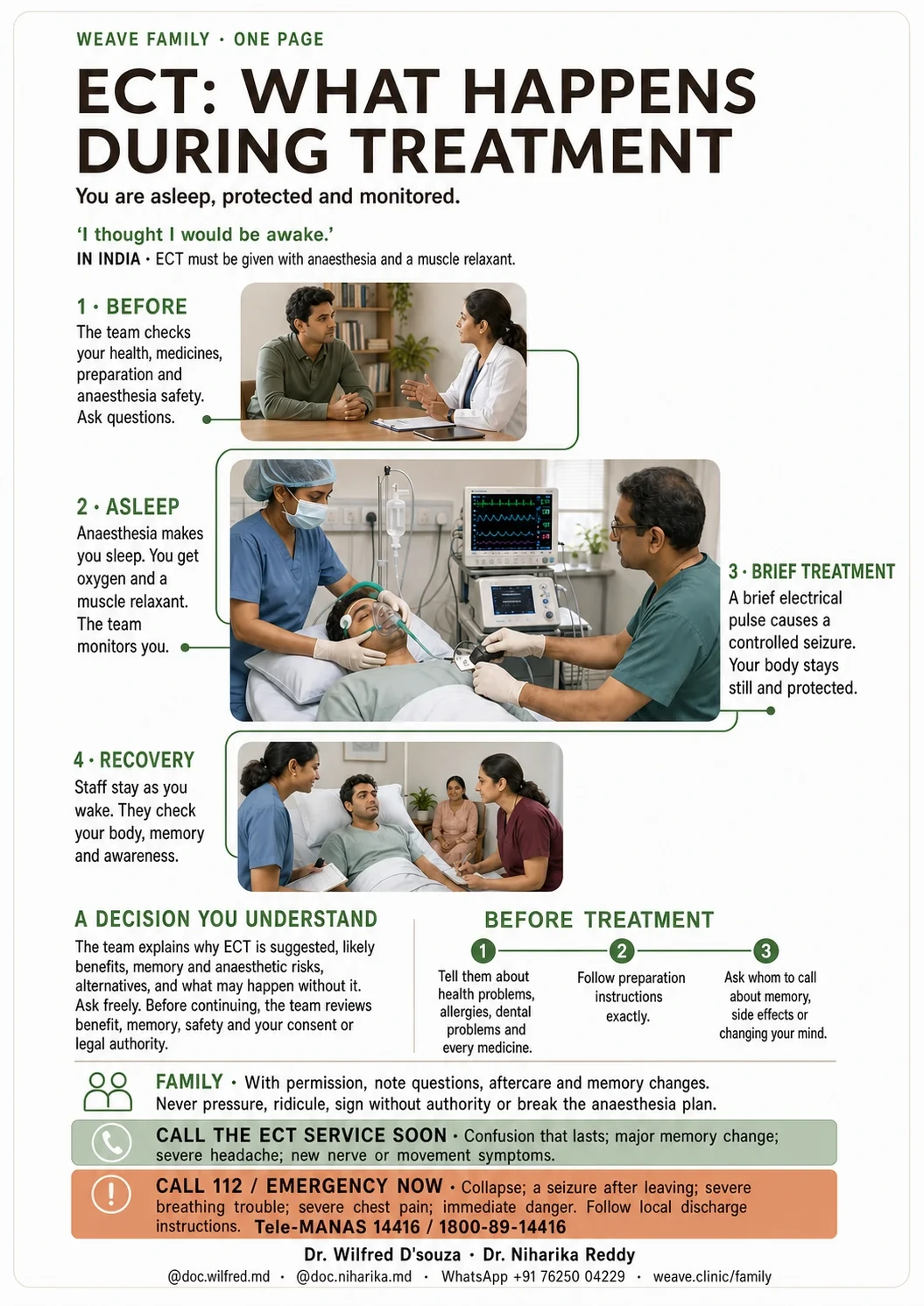
ECT: WHAT HAPPENS DURING TREATMENT

You are asleep, protected and monitored.

'I thought I would be awake.'

IN INDIA: ECT must be given with anaesthesia and a muscle relaxant.

1 BEFORE: The team checks your health, medicines, preparation and anaesthesia safety. Ask questions.

2 ASLEEP: Anaesthesia makes you sleep. You get oxygen and a muscle relaxant. The team monitors you.

3 BRIEF TREATMENT: A brief electrical pulse causes a controlled seizure. Your body stays still and protected.

4 RECOVERY: Staff stay as you wake. They check your body, memory and awareness.

A DECISION YOU UNDERSTAND: The team explains why ECT is suggested, likely benefits, memory and anaesthetic risks, alternatives, and what may happen without it.

BEFORE TREATMENT: Tell them about health problems, allergies, dental problems and every medicine. Follow preparation instructions exactly. Ask whom to call about memory, side effects or changing your mind.

FAMILY: With permission, note questions, aftercare and memory changes. Never pressure, ridicule, sign without authority or break the anaesthesia plan.

CALL THE ECT SERVICE SOON: Confusion that lasts; major memory change; severe headache; new nerve or movement symptoms.

CALL 112 OR EMERGENCY NOW: Collapse; a seizure after leaving; severe breathing trouble; severe chest pain; immediate danger. Tele-MANAS 14416 / 1800-89-14416.

Dr. Wilfred D'souza, Dr. Niharika Reddy. weave.clinic/family
For everyone

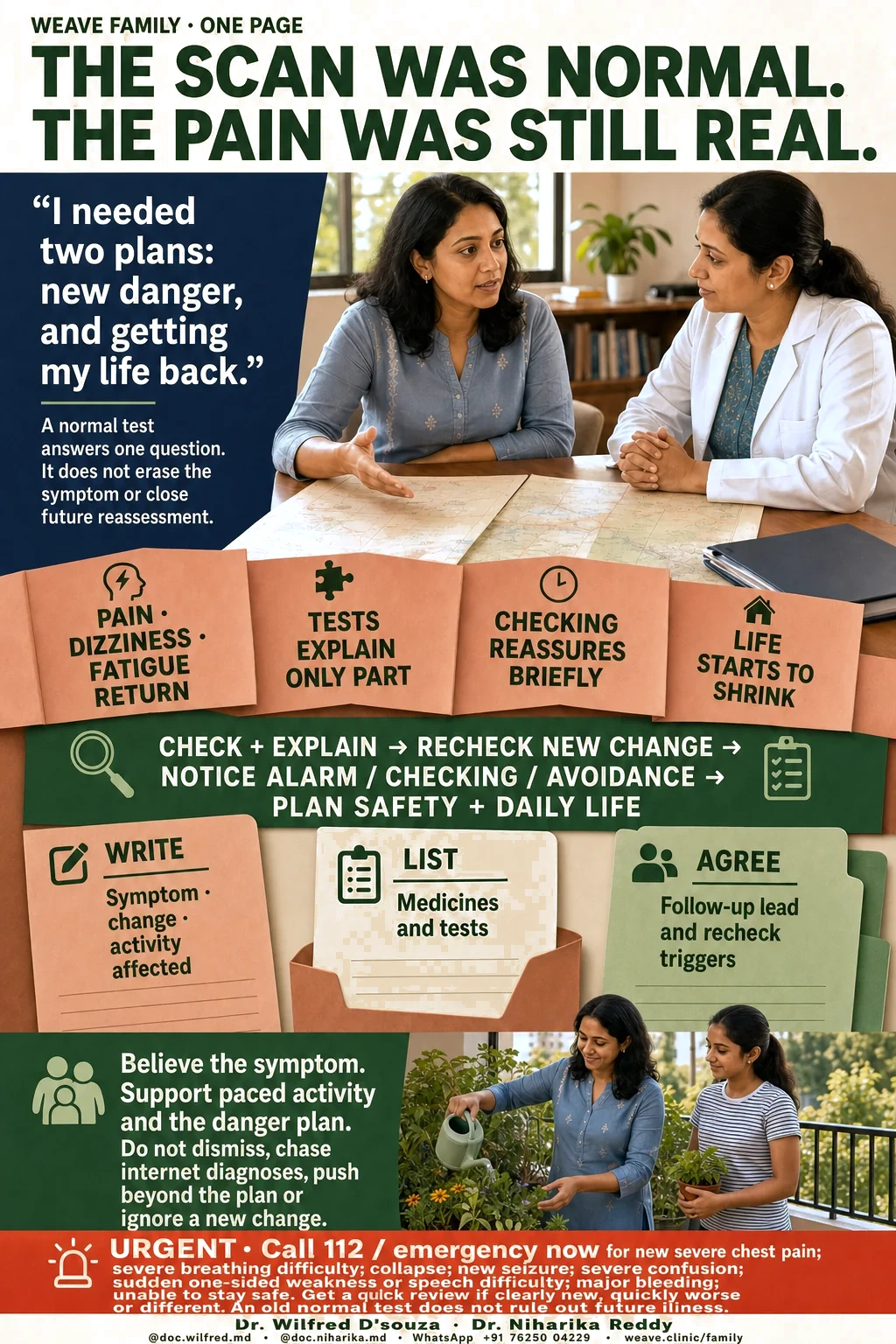
The scan was normal, the pain was still real

A normal test answers one question.

Read as text

WEAVE FAMILY, ONE PAGE

THE SCAN WAS NORMAL. THE PAIN WAS STILL REAL.

'I needed two plans: new danger, and getting my life back.'

A normal test answers one question. It does not erase the symptom or close future reassessment.

PAIN, DIZZINESS AND FATIGUE RETURN. TESTS EXPLAIN ONLY PART. CHECKING REASSURES BRIEFLY. LIFE STARTS TO SHRINK.

Check and explain, then recheck new change, then notice alarm, checking and avoidance, then plan safety and daily life.

WRITE: Symptom, change, activity affected. LIST: Medicines and tests. AGREE: Who leads follow-up, and what triggers a recheck.

FAMILY: Believe the symptom. Support paced activity and the danger plan. Do not dismiss, chase internet diagnoses, push beyond the plan or ignore a new change.

URGENT, CALL 112 OR EMERGENCY NOW: New severe chest pain; severe breathing difficulty; collapse; new seizure; severe confusion; sudden one-sided weakness or speech difficulty; major bleeding; unable to stay safe. Get a quick review if clearly new, quickly worse or different. An old normal test does not rule out future illness.

Dr. Wilfred D'souza, Dr. Niharika Reddy. weave.clinic/family
Low mood

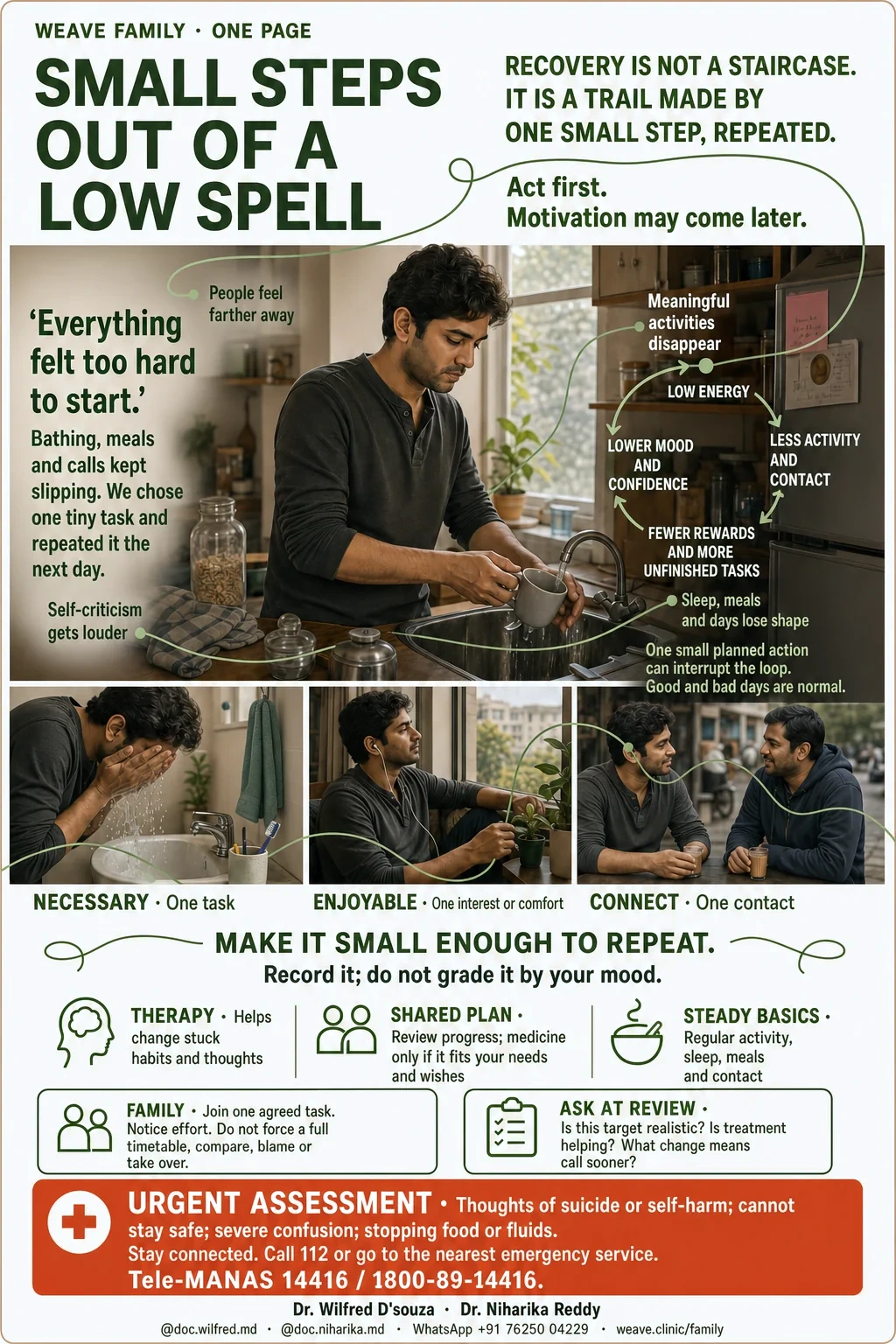
Small steps out of a low spell

Act first. Motivation comes later.

Read as text

WEAVE FAMILY, ONE PAGE

SMALL STEPS OUT OF A LOW SPELL

RECOVERY IS NOT A STAIRCASE. IT IS A TRAIL MADE BY ONE SMALL STEP, REPEATED.

Act first. Motivation may come later.

'Everything felt too hard to start.' Bathing, meals and calls kept slipping. We chose one tiny task and repeated it the next day.

Stuck signs: People feel farther away. Meaningful activities disappear. Self-criticism gets louder. Sleep, meals and days lose shape.

The loop: LOW ENERGY, then LESS ACTIVITY AND CONTACT, then FEWER REWARDS AND MORE UNFINISHED TASKS, then LOWER MOOD AND CONFIDENCE.

One small planned action can interrupt the loop. Good and bad days are normal.

NECESSARY: One task. ENJOYABLE: One interest or comfort. CONNECT: One contact.

MAKE IT SMALL ENOUGH TO REPEAT. Record it; do not grade it by your mood.

THERAPY: Helps change stuck habits and thoughts. SHARED PLAN: Review progress; medicine only if it fits your needs and wishes. STEADY BASICS: Regular activity, sleep, meals and contact.

FAMILY: Join one agreed task. Notice effort. Do not force a full timetable, compare, blame or take over.

ASK AT REVIEW: Is this target realistic? Is treatment helping? What change means call sooner?

URGENT ASSESSMENT: Thoughts of suicide or self-harm; cannot stay safe; severe confusion; stopping food or fluids. Stay connected. Call 112 or go to the nearest emergency service. Tele-MANAS 14416 / 1800-89-14416.

Dr. Wilfred D'souza, Dr. Niharika Reddy. weave.clinic/family
Low mood

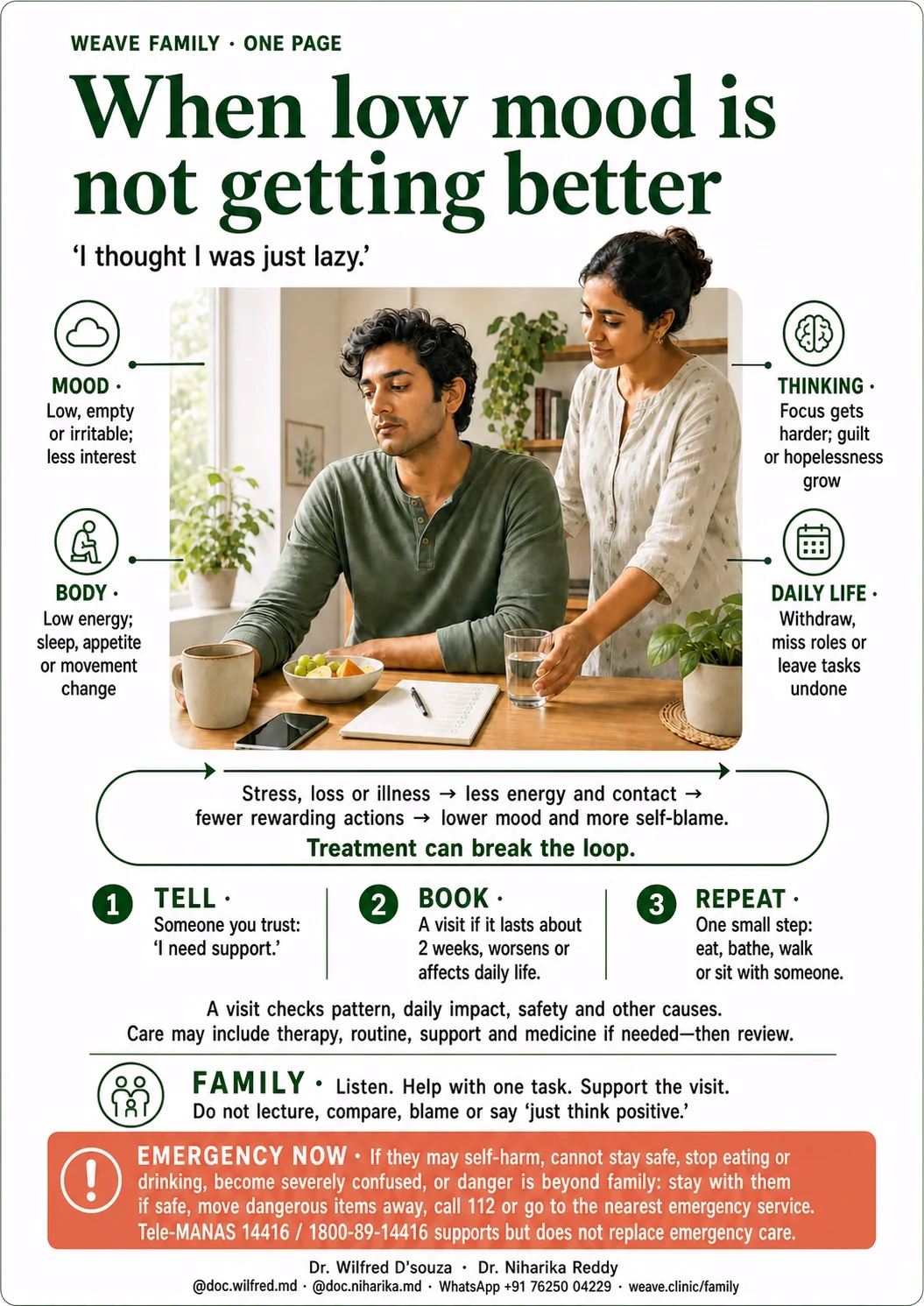
When low mood is not getting better

Two weeks is the signal to ask.

Read as text

WEAVE FAMILY, ONE PAGE

When low mood is not getting better

'I thought I was just lazy.'

MOOD: Low, empty or irritable; less interest. BODY: Low energy; sleep, appetite or movement change. THINKING: Focus gets harder; guilt or hopelessness grow. DAILY LIFE: Withdraw, miss roles or leave tasks undone.

Stress, loss or illness, then less energy and contact, then fewer rewarding actions, then lower mood and more self-blame. Treatment can break the loop.

1 TELL someone you trust: 'I need support.'

2 BOOK a visit if it lasts about 2 weeks, worsens or affects daily life.

3 REPEAT one small step: eat, bathe, walk or sit with someone.

A visit checks pattern, daily impact, safety and other causes. Care may include therapy, routine, support and medicine if needed, then review.

FAMILY: Listen. Help with one task. Support the visit. Do not lecture, compare, blame or say 'just think positive.'

EMERGENCY NOW: If they may self-harm, cannot stay safe, stop eating or drinking, become severely confused, or danger is beyond family: stay with them if safe, move dangerous items away, call 112 or go to the nearest emergency service. Tele-MANAS 14416 / 1800-89-14416 supports but does not replace emergency care.

Dr. Wilfred D'souza, Dr. Niharika Reddy. weave.clinic/family

Bipolar

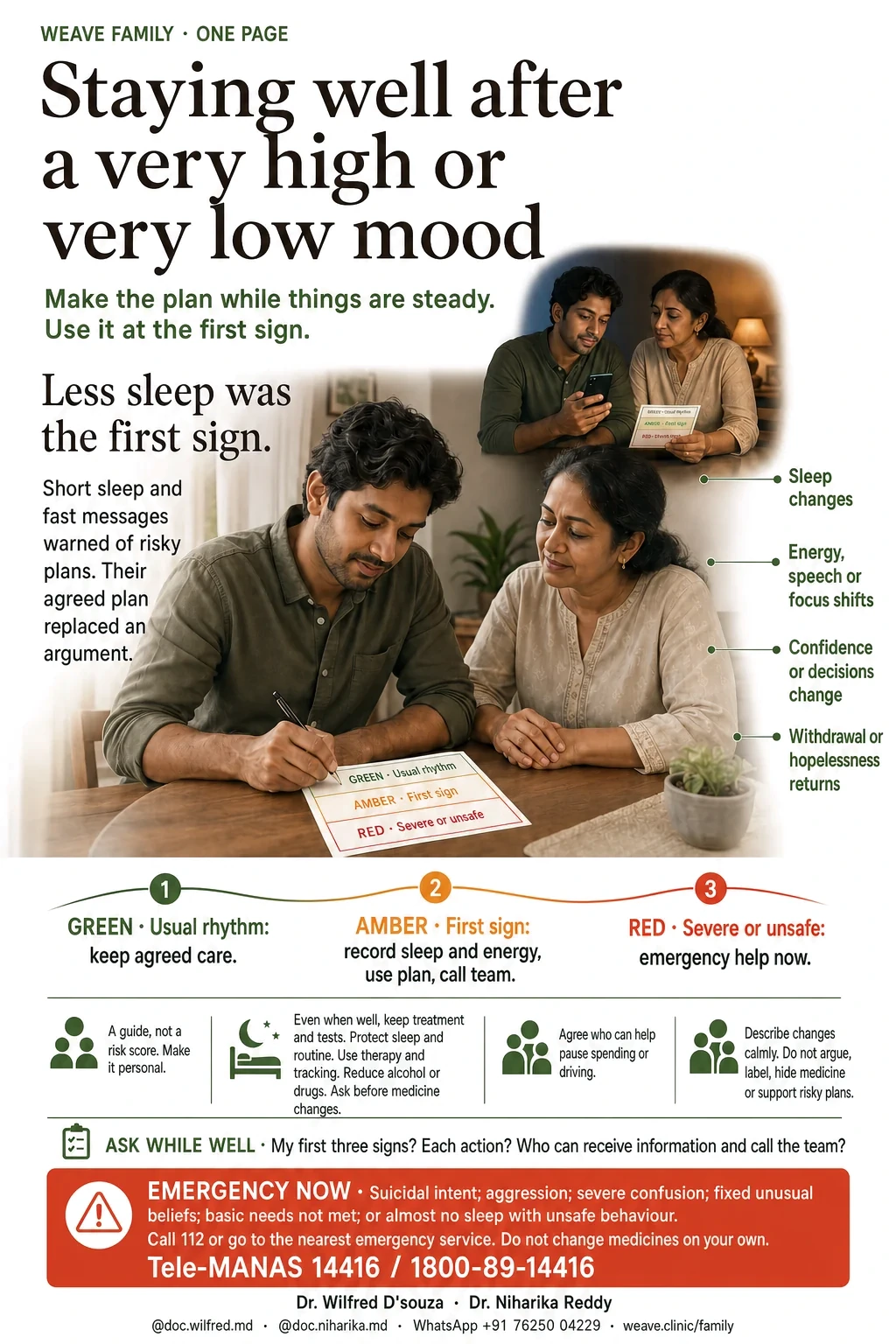
Staying well after a high or a low

Make the plan while things are steady.

Read as text

WEAVE FAMILY, ONE PAGE

Staying well after a very high or very low mood

Make the plan while things are steady. Use it at the first sign.

Less sleep was the first sign. Short sleep and fast messages warned of risky plans. Their agreed plan replaced an argument.

Personal signs: Sleep changes. Energy, speech or focus shifts. Confidence or decisions change. Withdrawal or hopelessness returns.

GREEN: Usual rhythm. AMBER: First sign. RED: Severe or unsafe.

1. GREEN, usual rhythm: keep agreed care.

2. AMBER, first sign: record sleep and energy, use plan, call team.

3. RED, severe or unsafe: emergency help now.

A guide, not a risk score. Make it personal.

Even when well, keep treatment and tests. Protect sleep and routine. Use therapy and tracking. Reduce alcohol or drugs. Ask before medicine changes.

Agree who can help pause spending or driving.

FAMILY: Describe changes calmly. Do not argue, label, hide medicine or support risky plans.

ASK WHILE WELL: My first three signs? Each action? Who can receive information and call the team?

EMERGENCY NOW: Suicidal intent; aggression; severe confusion; fixed unusual beliefs; basic needs not met; or almost no sleep with unsafe behaviour. Call 112 or go to the nearest emergency service. Do not change medicines on your own. Tele-MANAS 14416 / 1800-89-14416.

Dr. Wilfred D'souza, Dr. Niharika Reddy. weave.clinic/family
Bipolar

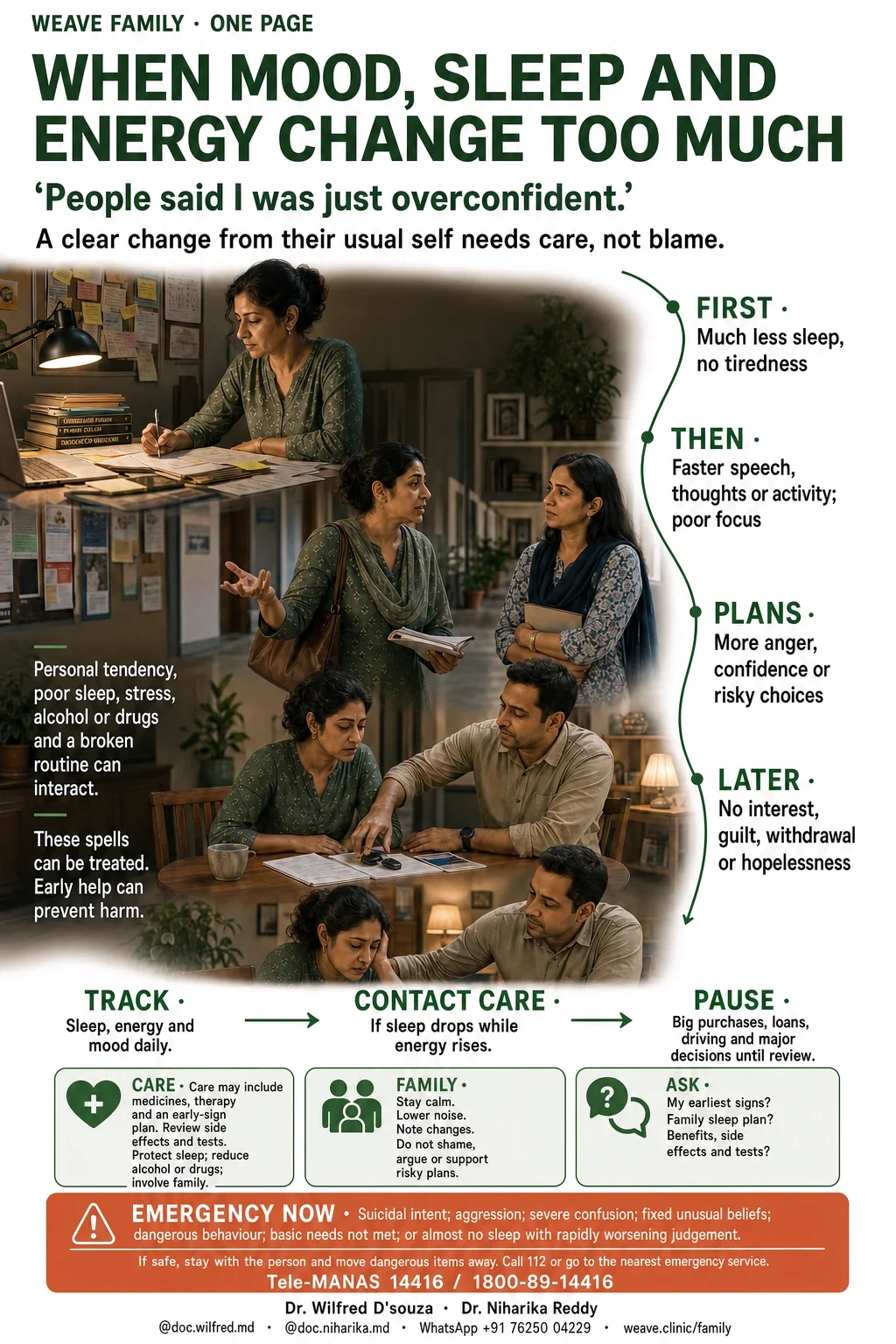
When mood, sleep and energy change too much

A clear change from their usual self needs care.

Read as text

WEAVE FAMILY, ONE PAGE

WHEN MOOD, SLEEP AND ENERGY CHANGE TOO MUCH

'People said I was just overconfident.'

A clear change from their usual self needs care, not blame.

Personal tendency, poor sleep, stress, alcohol or drugs and a broken routine can interact. These spells can be treated. Early help can prevent harm.

FIRST: Much less sleep, no tiredness. THEN: Faster speech, thoughts or activity; poor focus. PLANS: More anger, confidence or risky choices. LATER: No interest, guilt, withdrawal or hopelessness.

TRACK: Sleep, energy and mood daily. CONTACT CARE: If sleep drops while energy rises. PAUSE: Big purchases, loans, driving and major decisions until review.

CARE: Care may include medicines, therapy and an early-sign plan. Review side effects and tests. Protect sleep; reduce alcohol or drugs; involve family.

FAMILY: Stay calm. Lower noise. Note changes. Do not shame, argue or support risky plans.

ASK: My earliest signs? Family sleep plan? Benefits, side effects and tests?

EMERGENCY NOW: Suicidal intent; aggression; severe confusion; fixed unusual beliefs; dangerous behaviour; basic needs not met; or almost no sleep with rapidly worsening judgement. If safe, stay with the person and move dangerous items away. Call 112 or go to the nearest emergency service. Tele-MANAS 14416 / 1800-89-14416.

Dr. Wilfred D'souza, Dr. Niharika Reddy. weave.clinic/family
Bipolar

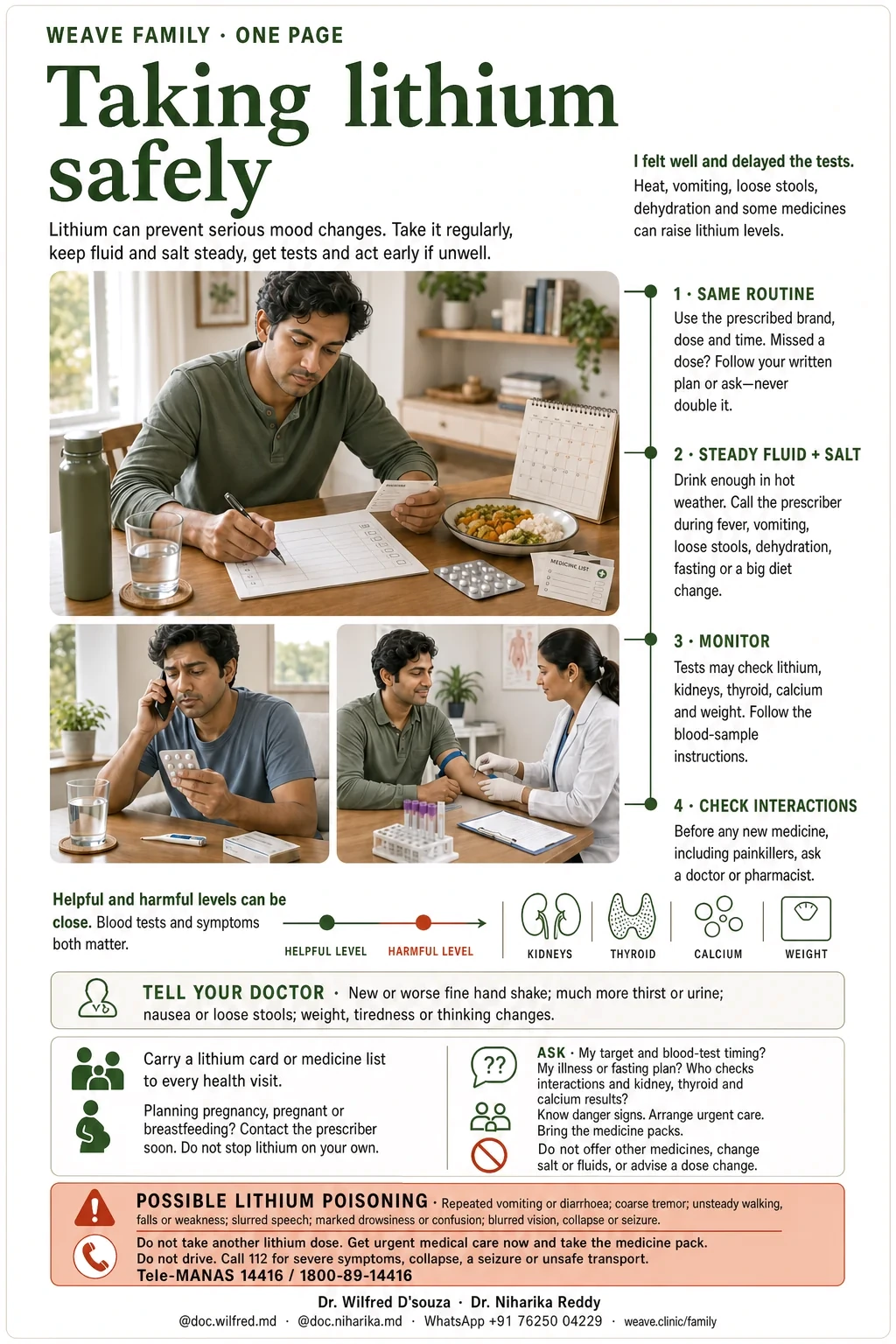
Taking lithium safely

Steady routine, steady fluid, regular tests.

Read as text

WEAVE FAMILY, ONE PAGE

Taking lithium safely

Lithium can prevent serious mood changes. Take it regularly, keep fluid and salt steady, get tests and act early if unwell.

'I felt well and delayed the tests.'

Heat, vomiting, loose stools, dehydration and some medicines can raise lithium levels.

1 SAME ROUTINE: Use the prescribed brand, dose and time. Missed a dose? Follow your written plan or ask, never double it.

2 STEADY FLUID AND SALT: Drink enough in hot weather. Call the prescriber during fever, vomiting, loose stools, dehydration, fasting or a big diet change.

3 MONITOR: Tests may check lithium, kidneys, thyroid, calcium and weight. Follow the blood-sample instructions.

4 CHECK INTERACTIONS: Before any new medicine, including painkillers, ask a doctor or pharmacist.

Helpful and harmful levels can be close. Blood tests and symptoms both matter.

TELL YOUR DOCTOR: New or worse fine hand shake; much more thirst or urine; nausea or loose stools; weight, tiredness or thinking changes.

Carry a lithium card or medicine list to every health visit. Planning pregnancy, pregnant or breastfeeding? Contact the prescriber soon. Do not stop lithium on your own.

FAMILY: Know danger signs. Arrange urgent care. Bring the medicine packs. Do not offer other medicines, change salt or fluids, or advise a dose change.

POSSIBLE LITHIUM POISONING: Repeated vomiting or diarrhoea; coarse tremor; unsteady walking, falls or weakness; slurred speech; marked drowsiness or confusion; blurred vision, collapse or seizure. Do not take another lithium dose. Get urgent medical care now and take the medicine pack. Do not drive. Call 112 for severe symptoms, collapse, a seizure or unsafe transport. Tele-MANAS 14416 / 1800-89-14416.

Dr. Wilfred D'souza, Dr. Niharika Reddy. weave.clinic/family
Anxiety

When worry will not stop

Planning acts. Worry circles.

Read as text

WEAVE FAMILY, ONE PAGE

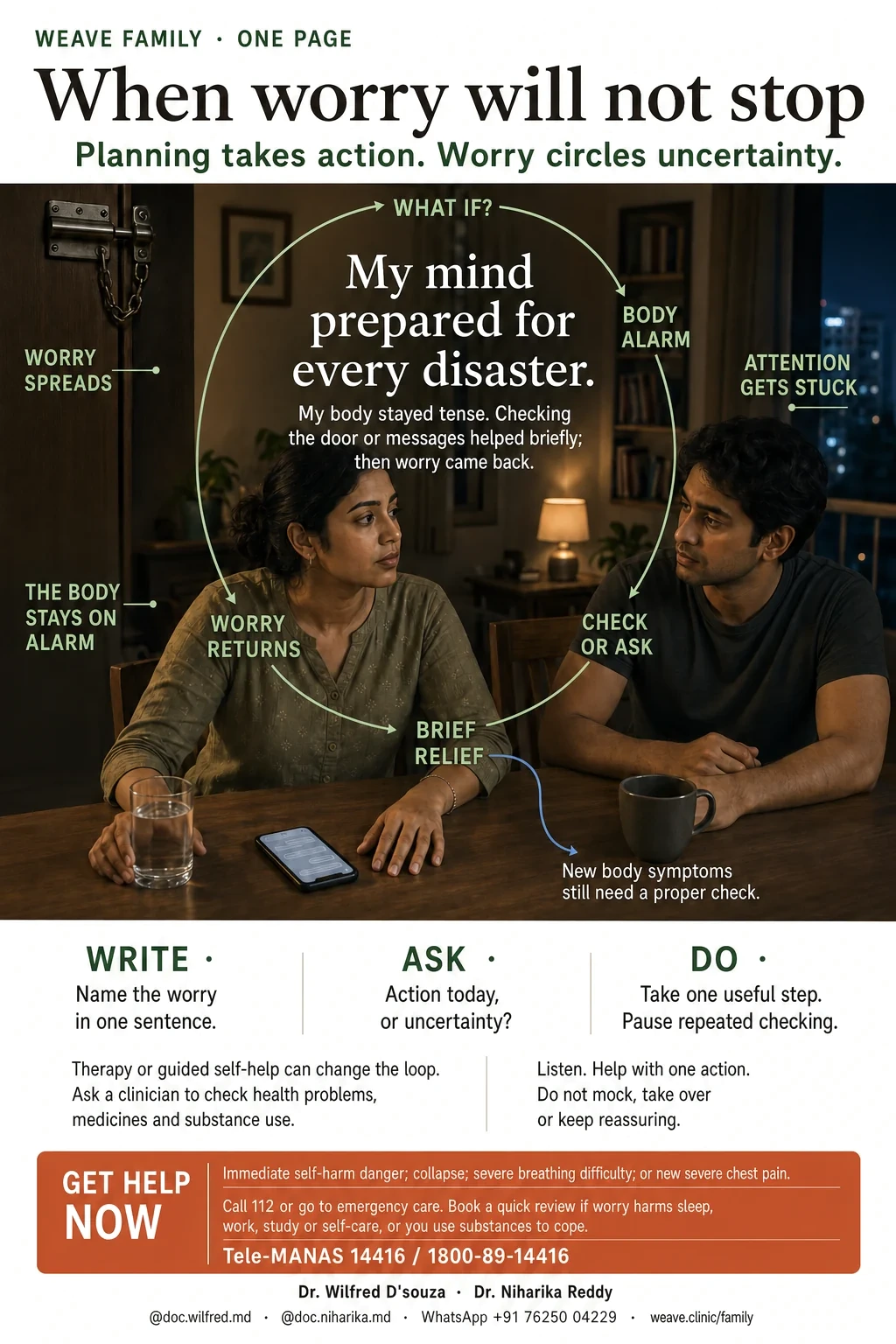
When worry will not stop

Planning takes action. Worry circles uncertainty.

WHAT IF? then BODY ALARM, then CHECK OR ASK, then BRIEF RELIEF, then WORRY RETURNS.

My mind prepared for every disaster. My body stayed tense. Checking the door or messages helped briefly; then worry came back.

WORRY SPREADS. ATTENTION GETS STUCK. THE BODY STAYS ON ALARM.

New body symptoms still need a proper check.

WRITE: Name the worry in one sentence. ASK: Action today, or uncertainty? DO: Take one useful step. Pause repeated checking.

Therapy or guided self-help can change the loop. Ask a clinician to check health problems, medicines and substance use.

FAMILY: Listen. Help with one action. Do not mock, take over or keep reassuring.

GET HELP NOW: Immediate self-harm danger; collapse; severe breathing difficulty; or new severe chest pain. Call 112 or go to emergency care. Book a quick review if worry harms sleep, work, study or self-care, or you use substances to cope. Tele-MANAS 14416 / 1800-89-14416.

Dr. Wilfred D'souza, Dr. Niharika Reddy. weave.clinic/family
Anxiety

When a worry arrives

Solvable now, or uncertainty to sit with?

Read as text

WEAVE FAMILY, ONE PAGE

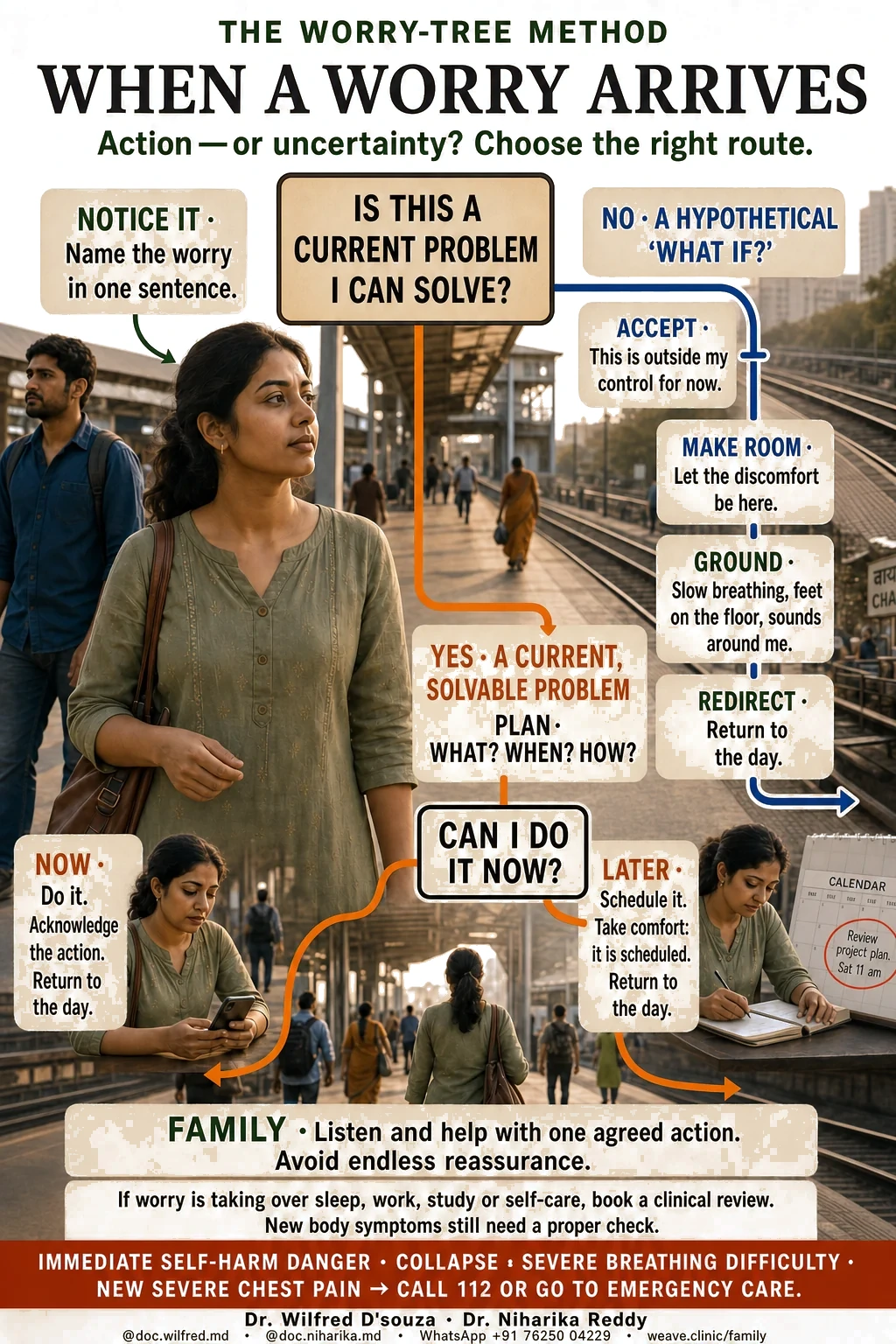
THE WORRY-TREE METHOD

WHEN A WORRY ARRIVES

Action, or uncertainty? Choose the right route.

NOTICE IT: Name the worry in one sentence.

IS THIS A CURRENT PROBLEM I CAN SOLVE?

NO, A HYPOTHETICAL WHAT IF: ACCEPT, this is outside my control for now. MAKE ROOM, let the discomfort be here. GROUND, slow breathing, feet on the floor, sounds around me. REDIRECT, return to the day.

YES, A CURRENT SOLVABLE PROBLEM: PLAN, what, when, how? CAN I DO IT NOW? NOW, do it and return to the day. LATER, schedule it, take comfort that it is scheduled, return to the day.

FAMILY: Listen and help with one agreed action. Avoid endless reassurance.

If worry is taking over sleep, work, study or self-care, book a clinical review. New body symptoms still need a proper check.

IMMEDIATE SELF-HARM DANGER, COLLAPSE, SEVERE BREATHING DIFFICULTY OR NEW SEVERE CHEST PAIN: call 112 or go to emergency care.

Dr. Wilfred D'souza, Dr. Niharika Reddy. weave.clinic/family

Anxiety

When fear hits suddenly

Escape brings relief, and a smaller map.

Read as text

WEAVE FAMILY, ONE PAGE

WHEN FEAR HITS SUDDENLY

AND SOME PLACES START TO FEEL UNSAFE

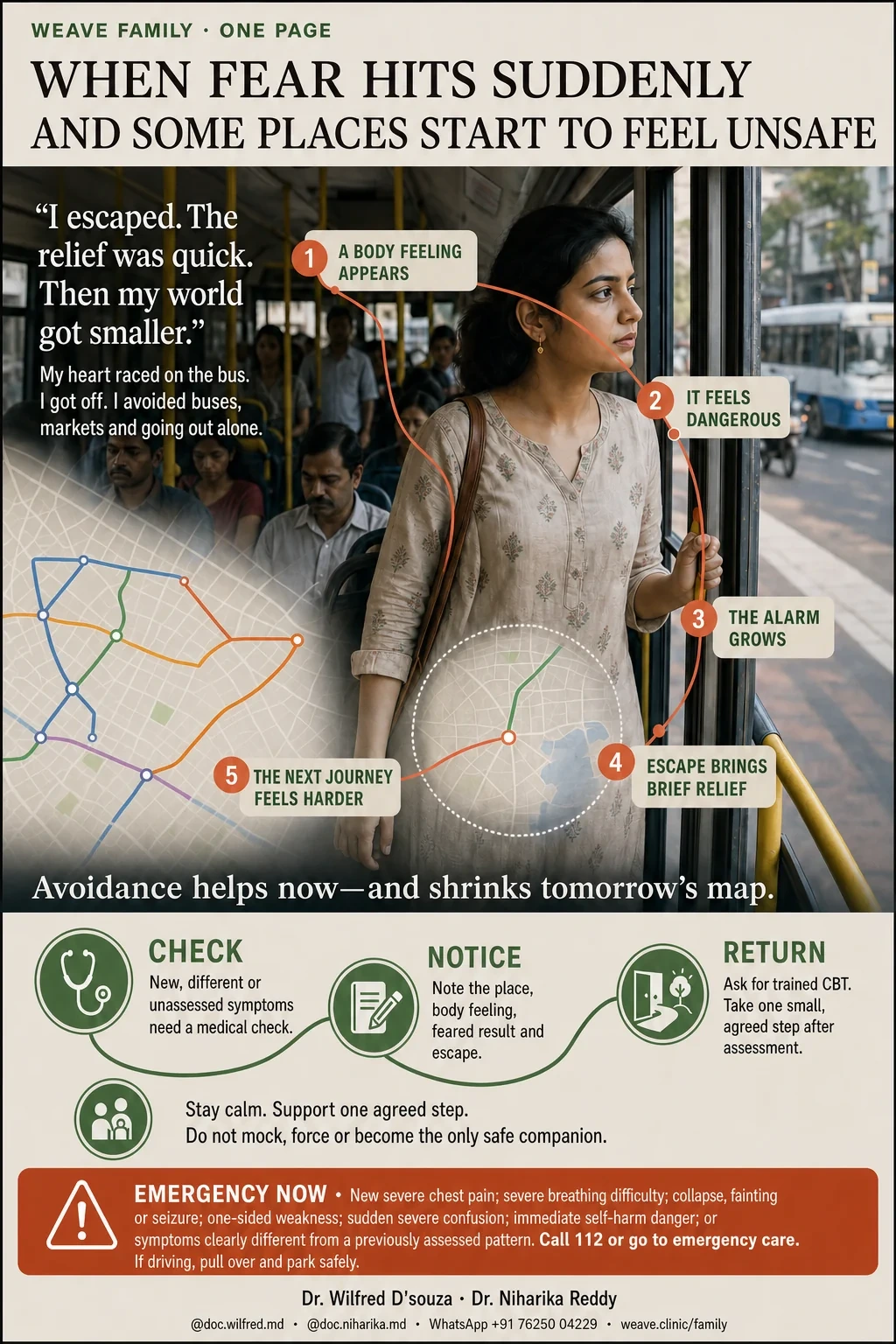
'I escaped. The relief was quick. Then my world got smaller.'

My heart raced on the bus. I got off. I avoided buses, markets and going out alone.

1 A BODY FEELING APPEARS. 2 IT FEELS DANGEROUS. 3 THE ALARM GROWS. 4 ESCAPE BRINGS BRIEF RELIEF. 5 THE NEXT JOURNEY FEELS HARDER.

Avoidance helps now, and shrinks tomorrow's map.

CHECK: New, different or unassessed symptoms need a medical check. NOTICE: Note the place, body feeling, feared result and escape. RETURN: Ask for trained CBT. Take one small, agreed step after assessment.

FAMILY: Stay calm. Support one agreed step. Do not mock, force or become the only safe companion.

EMERGENCY NOW: New severe chest pain; severe breathing difficulty; collapse, fainting or seizure; one-sided weakness; sudden severe confusion; immediate self-harm danger; or symptoms clearly different from a previously assessed pattern. Call 112 or go to emergency care. If driving, pull over and park safely.

Dr. Wilfred D'souza, Dr. Niharika Reddy. weave.clinic/family

OCD

When doubt demands one more check

Relief is brief. The doubt returns.

Read as text

WEAVE FAMILY, ONE PAGE

WHEN DOUBT DEMANDS ONE MORE CHECK

AND RELIEF NEVER LASTS

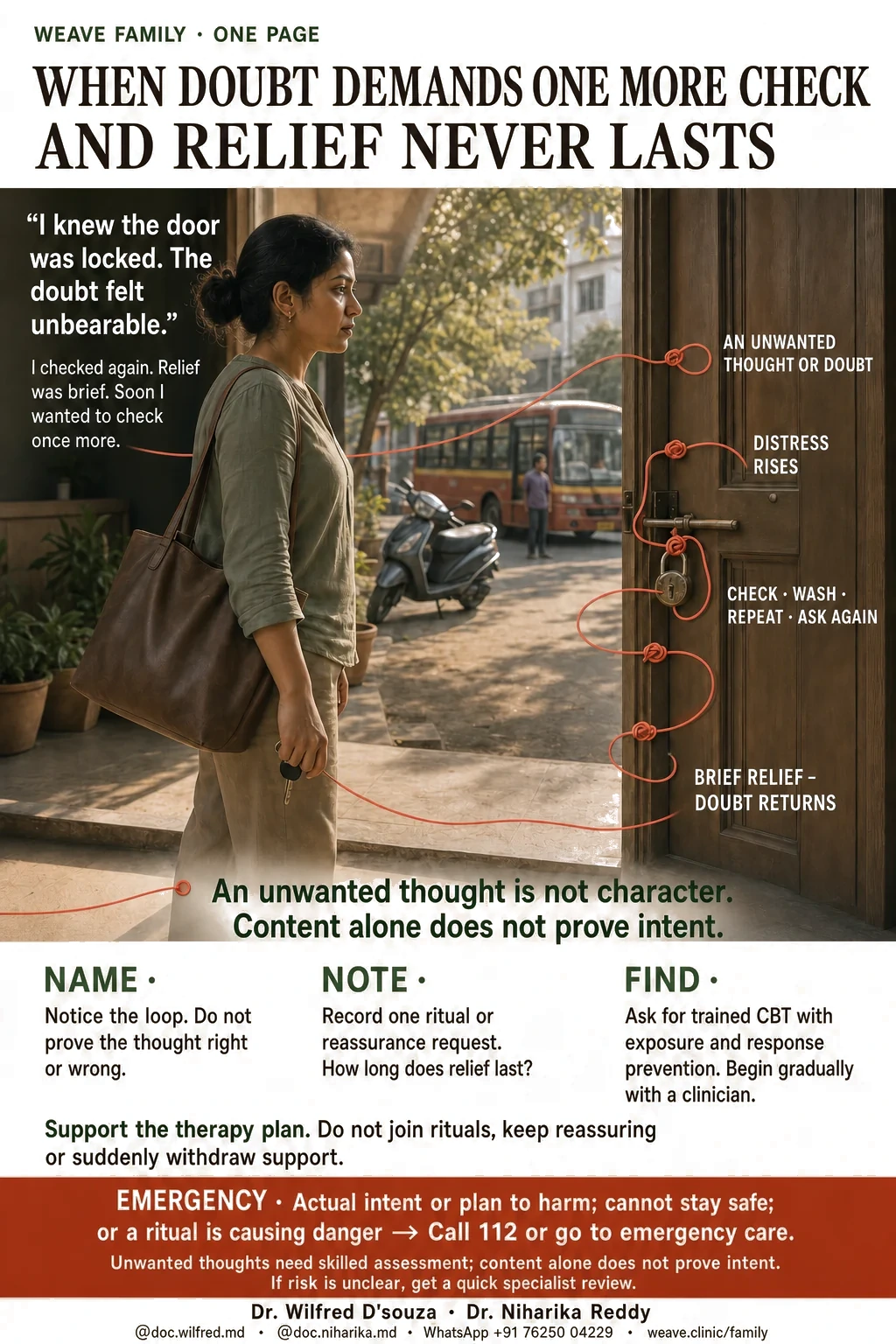
'I knew the door was locked. The doubt felt unbearable.'

I checked again. Relief was brief. Soon I wanted to check once more.

AN UNWANTED THOUGHT OR DOUBT, then DISTRESS RISES, then CHECK, WASH, REPEAT, ASK AGAIN, then BRIEF RELIEF, then DOUBT RETURNS.

An unwanted thought is not character. Content alone does not prove intent.

NAME: Notice the loop. Do not prove the thought right or wrong. NOTE: Record one ritual or reassurance request. How long does relief last? FIND: Ask for trained CBT with exposure and response prevention. Begin gradually with a clinician.

FAMILY: Support the therapy plan. Do not join rituals, keep reassuring or suddenly withdraw support.

EMERGENCY: Actual intent or plan to harm; cannot stay safe; or a ritual is causing danger. Call 112 or go to emergency care. Unwanted thoughts need skilled assessment; content alone does not prove intent. If risk is unclear, get a quick specialist review.

Dr. Wilfred D'souza, Dr. Niharika Reddy. weave.clinic/family

Trauma

The danger ended, so why does my body still react?

An old alarm, not weakness.

Read as text

WEAVE FAMILY, ONE PAGE

THE DANGER ENDED. WHY DOES MY BODY STILL REACT?

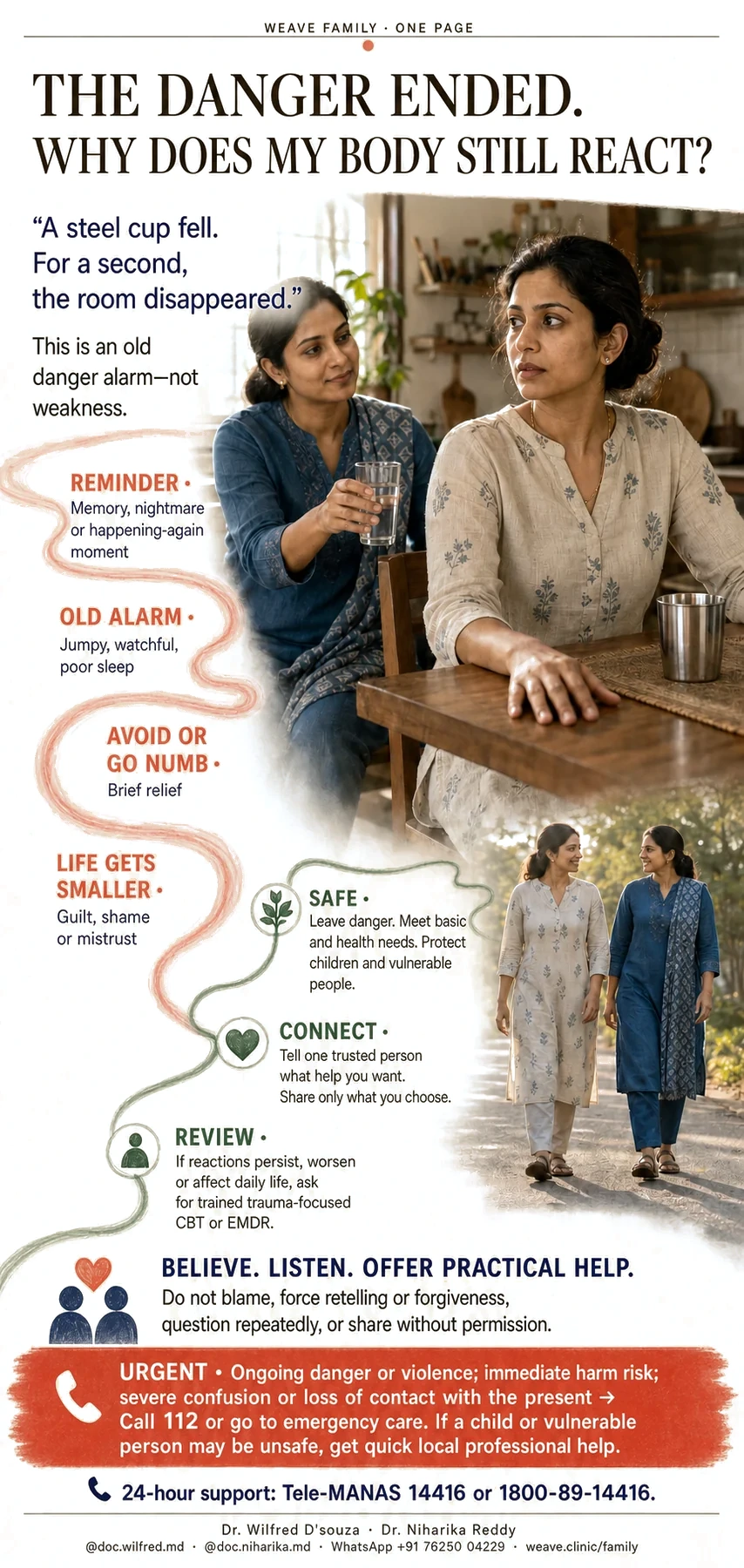
'A steel cup fell. For a second, the room disappeared.'

This is an old danger alarm, not weakness.

REMINDER: Memory, nightmare or happening-again moment. OLD ALARM: Jumpy, watchful, poor sleep. AVOID OR GO NUMB: Brief relief. LIFE GETS SMALLER: Guilt, shame or mistrust.

SAFE: Leave danger. Meet basic and health needs. Protect children and vulnerable people.

CONNECT: Tell one trusted person what help you want. Share only what you choose.

REVIEW: If reactions persist, worsen or affect daily life, ask for trained trauma-focused CBT or EMDR.

BELIEVE. LISTEN. OFFER PRACTICAL HELP. Do not blame, force retelling or forgiveness, question repeatedly, or share without permission.

URGENT: Ongoing danger or violence; immediate harm risk; severe confusion or loss of contact with the present. Call 112 or go to emergency care. If a child or vulnerable person may be unsafe, get quick local professional help. 24-hour support: Tele-MANAS 14416 or 1800-89-14416.

Dr. Wilfred D'souza, Dr. Niharika Reddy. weave.clinic/family

Unusual experiences

When the world feels different and completely real

The fear is real. The cause needs checking.

Read as text

WEAVE FAMILY, ONE PAGE

WHEN THE WORLD FEELS DIFFERENT AND COMPLETELY REAL

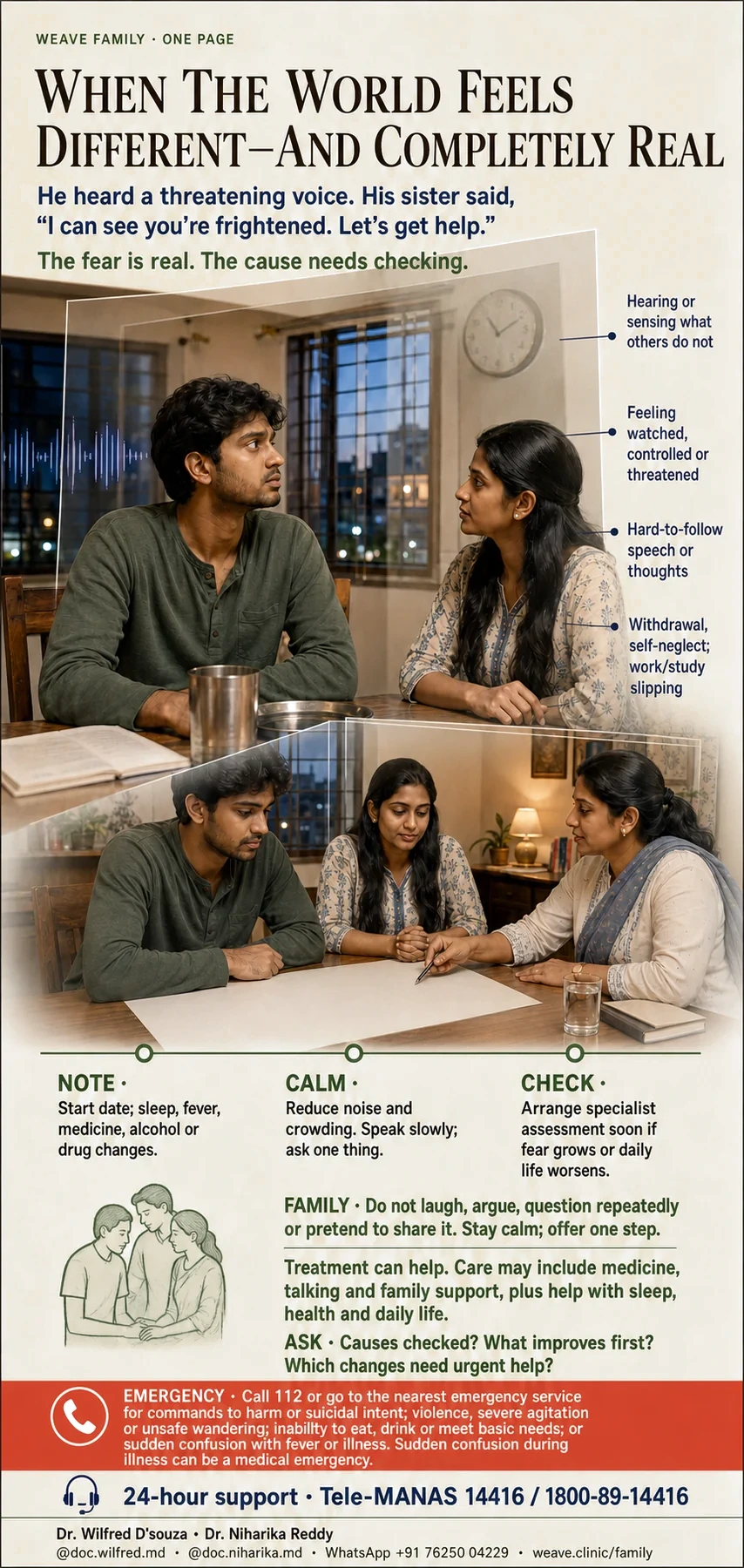
He heard a threatening voice. His sister said, 'I can see you're frightened. Let's get help.'

The fear is real. The cause needs checking.

Hearing or sensing what others do not. Feeling watched, controlled or threatened. Hard-to-follow speech or thoughts. Withdrawal, self-neglect; work or study slipping.

NOTE: Start date; sleep, fever, medicine, alcohol or drug changes. CALM: Reduce noise and crowding. Speak slowly; ask one thing. CHECK: Arrange specialist assessment soon if fear grows or daily life worsens.

FAMILY: Do not laugh, argue, question repeatedly or pretend to share it. Stay calm; offer one step.

Treatment can help. Care may include medicine, talking and family support, plus help with sleep, health and daily life.

ASK: Causes checked? What improves first? Which changes need urgent help?

EMERGENCY: Call 112 or go to the nearest emergency service if there are commands to harm or suicidal intent; violence, severe agitation or unsafe wandering; inability to eat, drink or meet basic needs; or sudden confusion with fever or illness. Sudden confusion during illness can be a medical emergency. 24-hour support: Tele-MANAS 14416 / 1800-89-14416.

Dr. Wilfred D'souza, Dr. Niharika Reddy. weave.clinic/family
Unusual experiences

You do not have to win the argument

Accept the fear without agreeing.

Read as text

WEAVE FAMILY, ONE PAGE

YOU DO NOT HAVE TO WIN THE ARGUMENT TO KEEP THEM SAFE

'I do not hear it. I can see you are frightened. Let us go somewhere quiet and call the team.'

The fear can feel real. Arguments, rapid questions and shame can raise fear and weaken trust. Families need support too.

Accept the fear without pretending the belief is true.

ONE VOICE: One person speaks in short, respectful sentences. ASK: What would feel safer right now? CALL EARLY: Note sleep, self-care and behaviour changes. Call the care team.

Give space. Offer food and water. Reduce noise. Keep a simple routine.

Do not laugh, threaten, crowd, secretly record, use force or follow unsafe demands. Do not give any medicine that has not been prescribed.

Agree care and crisis steps. Say when danger cannot stay secret. Get support for carers too.

ASK: What can family know? Early signs and actions? Carer support?

DO NOT MANAGE DANGER ALONE: Keep a safe distance if needed. Call 112 or go to the nearest emergency service for immediate danger; commands to harm or suicidal intent; violence, severe confusion or unsafe wandering; or inability to eat, drink or meet basic needs. Do not use force. 24-hour support: Tele-MANAS 14416 / 1800-89-14416.

Dr. Wilfred D'souza, Dr. Niharika Reddy. weave.clinic/family
Substance use

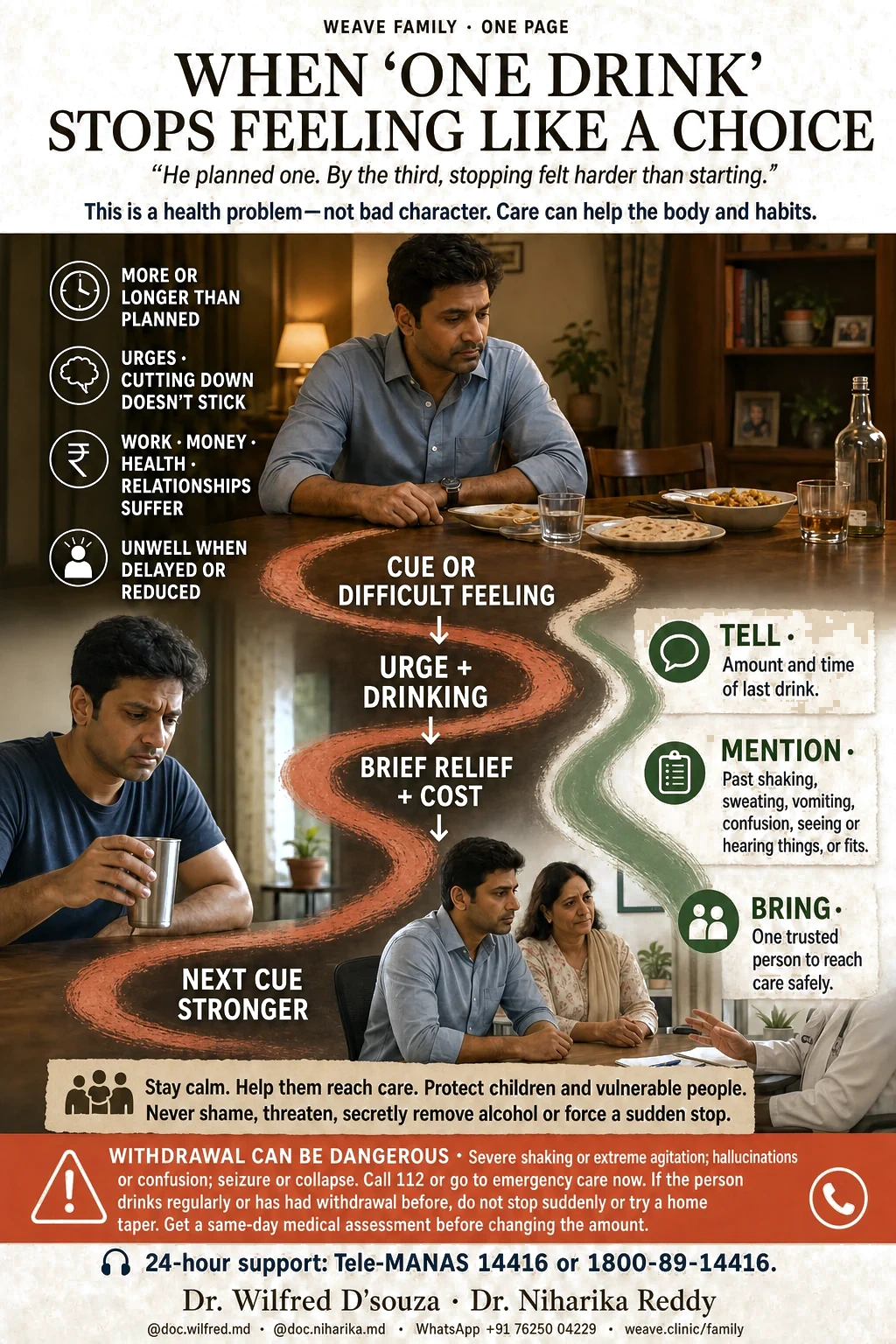
When one drink stops feeling like a choice

A health problem, not bad character.

Read as text

WEAVE FAMILY, ONE PAGE

WHEN ONE DRINK STOPS FEELING LIKE A CHOICE

'He planned one. By the third, stopping felt harder than starting.'

This is a health problem, not bad character. Care can help the body and habits.

MORE OR LONGER THAN PLANNED. URGES, CUTTING DOWN DOES NOT STICK. WORK, MONEY, HEALTH AND RELATIONSHIPS SUFFER. UNWELL WHEN DELAYED OR REDUCED.

Cue or difficult feeling, then urge and drinking, then brief relief and cost, then the next cue is stronger.

TELL: Amount and time of last drink. MENTION: Past shaking, sweating, vomiting, confusion, seeing or hearing things, or fits. BRING: One trusted person to reach care safely.

FAMILY: Stay calm. Help them reach care. Protect children and vulnerable people. Never shame, threaten, secretly remove alcohol or force a sudden stop.

WITHDRAWAL CAN BE DANGEROUS: Severe shaking or extreme agitation; hallucinations or confusion; seizure or collapse. Call 112 or go to emergency care now. If the person drinks regularly or has had withdrawal before, do not stop suddenly or try a home taper. Get a same-day medical assessment before changing the amount. 24-hour support: Tele-MANAS 14416 or 1800-89-14416.

Dr. Wilfred D'souza, Dr. Niharika Reddy. weave.clinic/family

Substance use

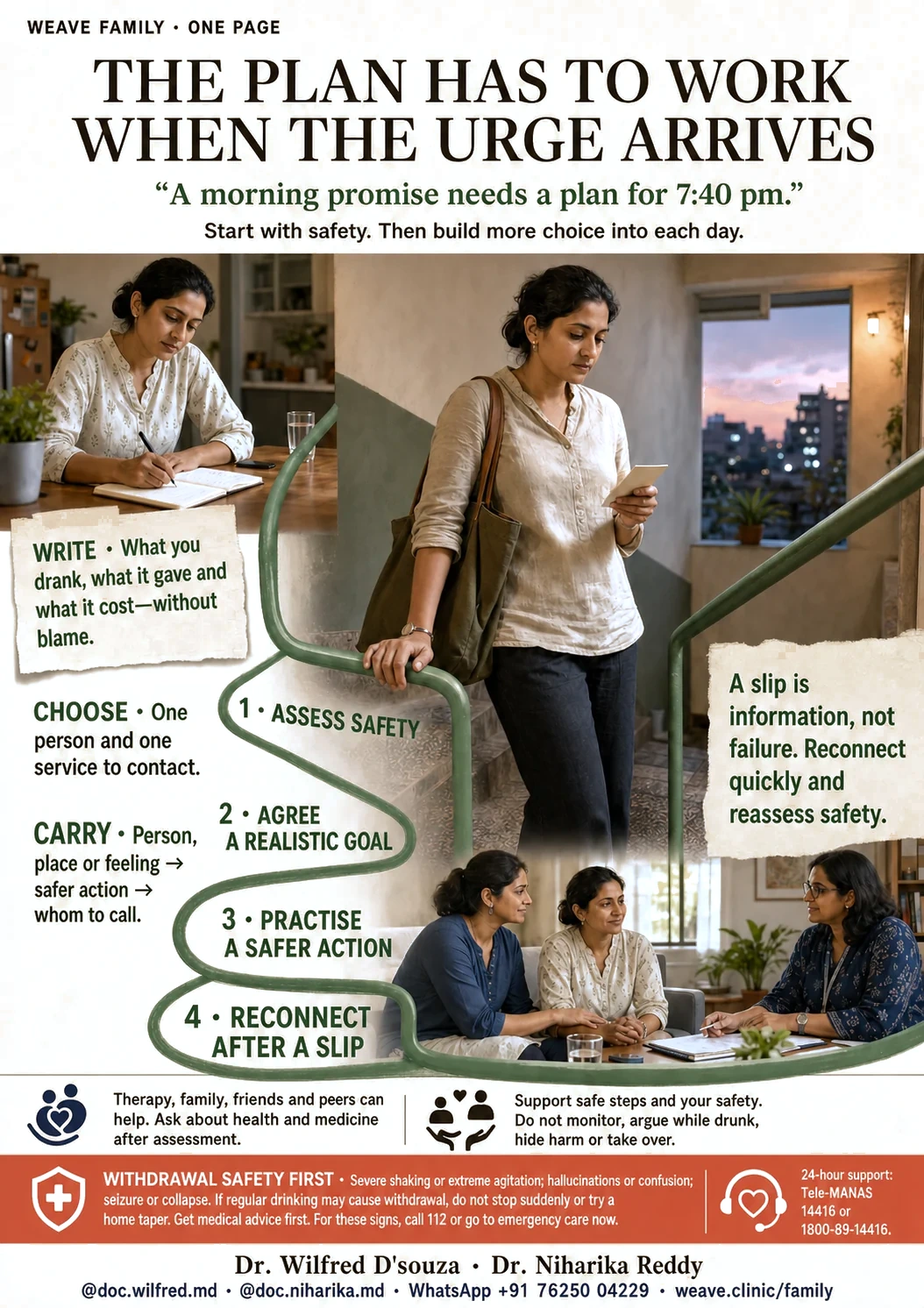
The plan has to work when the urge arrives

A slip is information, not failure.

Read as text

WEAVE FAMILY, ONE PAGE

THE PLAN HAS TO WORK WHEN THE URGE ARRIVES

'A morning promise needs a plan for 7:40 pm.'

Start with safety. Then build more choice into each day.

WRITE: What you drank, what it gave and what it cost, without blame. CHOOSE: One person and one service to contact. CARRY: Person, place or feeling, then safer action, then whom to call.

1 ASSESS SAFETY. 2 AGREE A REALISTIC GOAL. 3 PRACTISE A SAFER ACTION. 4 RECONNECT AFTER A SLIP.

A slip is information, not failure. Reconnect quickly and reassess safety.

Therapy, family, friends and peers can help. Ask about health and medicine after assessment.

FAMILY: Support safe steps and your own safety. Do not police, argue while drunk, hide harm or take over.

WITHDRAWAL SAFETY FIRST: Severe shaking or extreme agitation; hallucinations or confusion; seizure or collapse. For these signs, call 112 or go to emergency care now. If regular drinking may cause withdrawal, do not stop suddenly or try a home taper. Get medical advice first. 24-hour support: Tele-MANAS 14416 or 1800-89-14416.

Dr. Wilfred D'souza, Dr. Niharika Reddy. weave.clinic/family

Substance use

When your hand moves before you decide

Craving is a body signal, not weak will.

Read as text

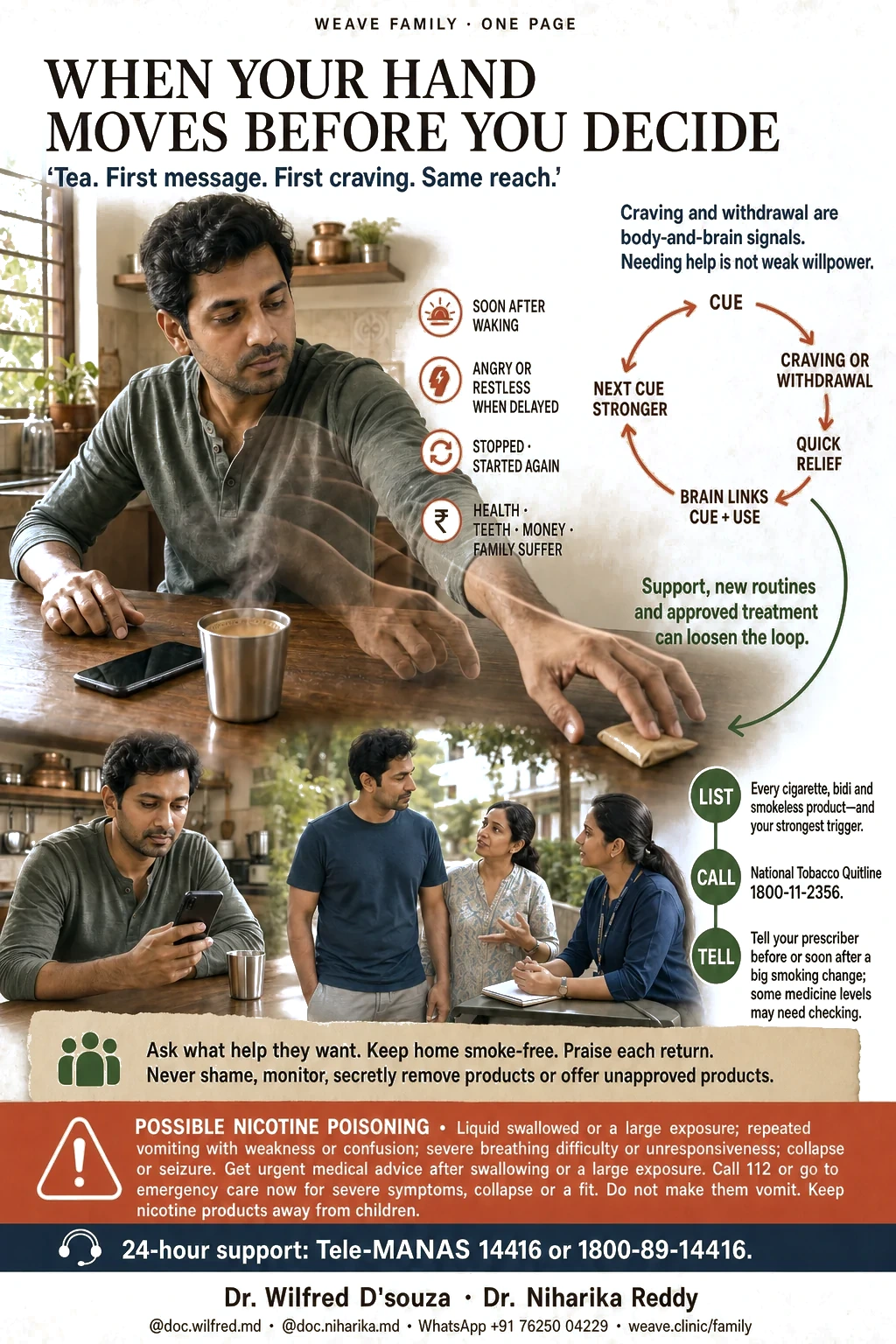
WEAVE FAMILY, ONE PAGE

WHEN YOUR HAND MOVES BEFORE YOU DECIDE

'Tea. First message. First craving. Same reach.'

Craving and withdrawal are body-and-brain signals. Needing help is not weak willpower.

SOON AFTER WAKING. ANGRY OR RESTLESS WHEN DELAYED. STOPPED, STARTED AGAIN. HEALTH, TEETH, MONEY AND FAMILY SUFFER.

Cue, then craving or withdrawal, then quick relief, then the brain links cue and use, then the next cue is stronger.

Support, new routines and approved treatment can loosen the loop.

LIST: Every cigarette, bidi and smokeless product, and your strongest trigger. CALL: National Tobacco Quitline 1800-11-2356. TELL: Tell your prescriber before or soon after a big smoking change; some medicine levels may need checking.

FAMILY: Ask what help they want. Keep home smoke-free. Praise each return. Never shame, police, secretly remove products or offer unapproved products.

POSSIBLE NICOTINE POISONING: Liquid swallowed or a large exposure; repeated vomiting with weakness or confusion; severe breathing difficulty or unresponsiveness; collapse or seizure. Get urgent medical advice after swallowing or a large exposure. Call 112 or go to emergency care now for severe symptoms, collapse or a fit. Do not make them vomit. Keep nicotine products away from children. 24-hour support: Tele-MANAS 14416 or 1800-89-14416.

Dr. Wilfred D'souza, Dr. Niharika Reddy. weave.clinic/family

Substance use

When short relief costs more

Tell the truth. Care should protect.

Read as text

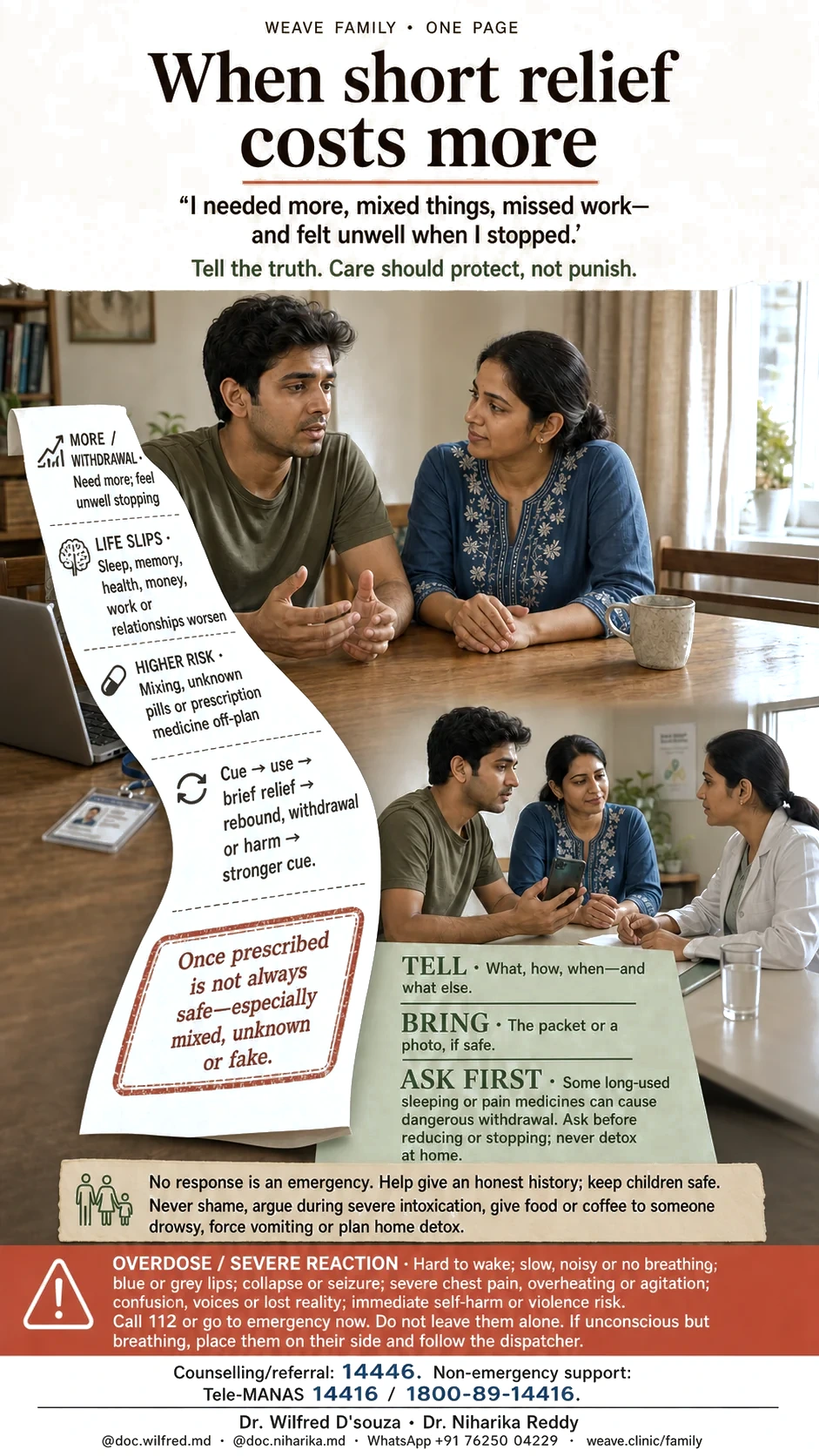
WEAVE FAMILY, ONE PAGE

When short relief costs more

'I needed more, mixed things, missed work, and felt unwell when I stopped.'

Tell the truth. Care should protect, not punish.

MORE OR WITHDRAWAL: Need more; feel unwell stopping. LIFE SLIPS: Sleep, memory, health, money, work or relationships worsen. HIGHER RISK: Mixing, unknown pills or prescription medicine off-plan.

Cue, then use, then brief relief, then rebound, withdrawal or harm, then a stronger cue.

Once prescribed is not always safe, especially mixed, unknown or fake.

TELL: What, how, when, and what else. BRING: The packet or a photo, if safe. ASK FIRST: Some long-used sleeping or pain medicines can cause dangerous withdrawal. Ask before reducing or stopping; never detox at home.

FAMILY: Unresponsiveness is an emergency. Help give an honest history; keep children safe. Never shame, argue during severe intoxication, give food or coffee to someone drowsy, force vomiting or plan home detox.

OVERDOSE OR SEVERE REACTION: Hard to wake; slow, noisy or no breathing; blue or grey lips; collapse or seizure; severe chest pain, overheating or agitation; confusion, voices or lost reality; immediate self-harm or violence risk. Call 112 or go to emergency now. Do not leave them alone. If unconscious but breathing, place them on their side and follow the dispatcher. Counselling and referral: 14446. Non-emergency support: Tele-MANAS 14416 / 1800-89-14416.

Dr. Wilfred D'souza, Dr. Niharika Reddy. weave.clinic/family
Neurodivergence

When all afternoon becomes three minutes

Ask for a proper assessment. It is not laziness.

Read as text

WEAVE FAMILY, ONE PAGE

When 'all afternoon' becomes three minutes

At 10:05 she had time. At 4:57 the deadline became the only thing in the room.

If this began in childhood and affects daily life, ask for a proper assessment. It is not laziness.

Lose instructions, belongings or time. Start often; routine tasks stall. Restless, interrupt or find waiting hard. Across home, study, work or relationships.

Focus changes with interest, urgency and surroundings. Noise, poor sleep and long tasks make it harder. Also note mood, learning, health, medicines and substance use.

Favourite-task focus does not rule it out. Checklists cannot diagnose it.

WRITE: Two recent examples and what went wrong. TRACE: Childhood clues if available. Reports help; they are not essential. BOOK: A trained specialist checks childhood, different settings, strengths and other causes.

FAMILY: Give examples, support routines, let them speak. Never use lazy labels, blame parenting, shame or checklist-diagnose.

NOT ROUTINE ATTENTION PROBLEMS: Collapse, first seizure, severe breathing difficulty, severe chest pain, sudden severe confusion or immediate danger of harm. Call 112 or go to emergency now. Non-emergency support: Tele-MANAS 14416 / 1800-89-14416.

Dr. Wilfred D'souza, Dr. Niharika Reddy. weave.clinic/family
Neurodivergence

Make the task small enough to start

Three visible steps beat trying harder.

Read as text

WEAVE FAMILY, ONE PAGE

Make the task small enough to start

'Try harder' gave her a wall. Three visible steps gave her a door.

Clear routines and the right support can make home and school easier.

LARGE, VAGUE OR MANY STEPS. NOISE, SCREENS AND ACTIVITY COMPETE. CHECK SLEEP, APPETITE, MOOD AND SIDE EFFECTS.

Adjust the setup, then teach one skill, then add clinician-chosen treatment if needed, then review benefit and side effects.

HOME: One fixed place. Next step visible. CHUNK: One clear start, short steps and movement breaks. NOTE: Track daily benefit, sleep, appetite, mood and side effects.

The aim is easier daily life, not a different personality.

FAMILY: Agree reminders, praise systems and ask before taking over. Never nag, remove supports suddenly, treat missed steps as defiance, share medicine or change dose.

URGENT: Call 112 or go to emergency now for severe chest pain, collapse or fainting, breathing difficulty, seizure, severe agitation or confusion, or immediate danger of harm. Contact the prescriber soon for worrying new side effects or marked mood, sleep or appetite changes. Never give extra medicine, share it or stop it suddenly without medical advice.

Dr. Wilfred D'souza, Dr. Niharika Reddy. weave.clinic/family

Neurodivergence

The room had rules no one said out loud

Support removes barriers.

Read as text

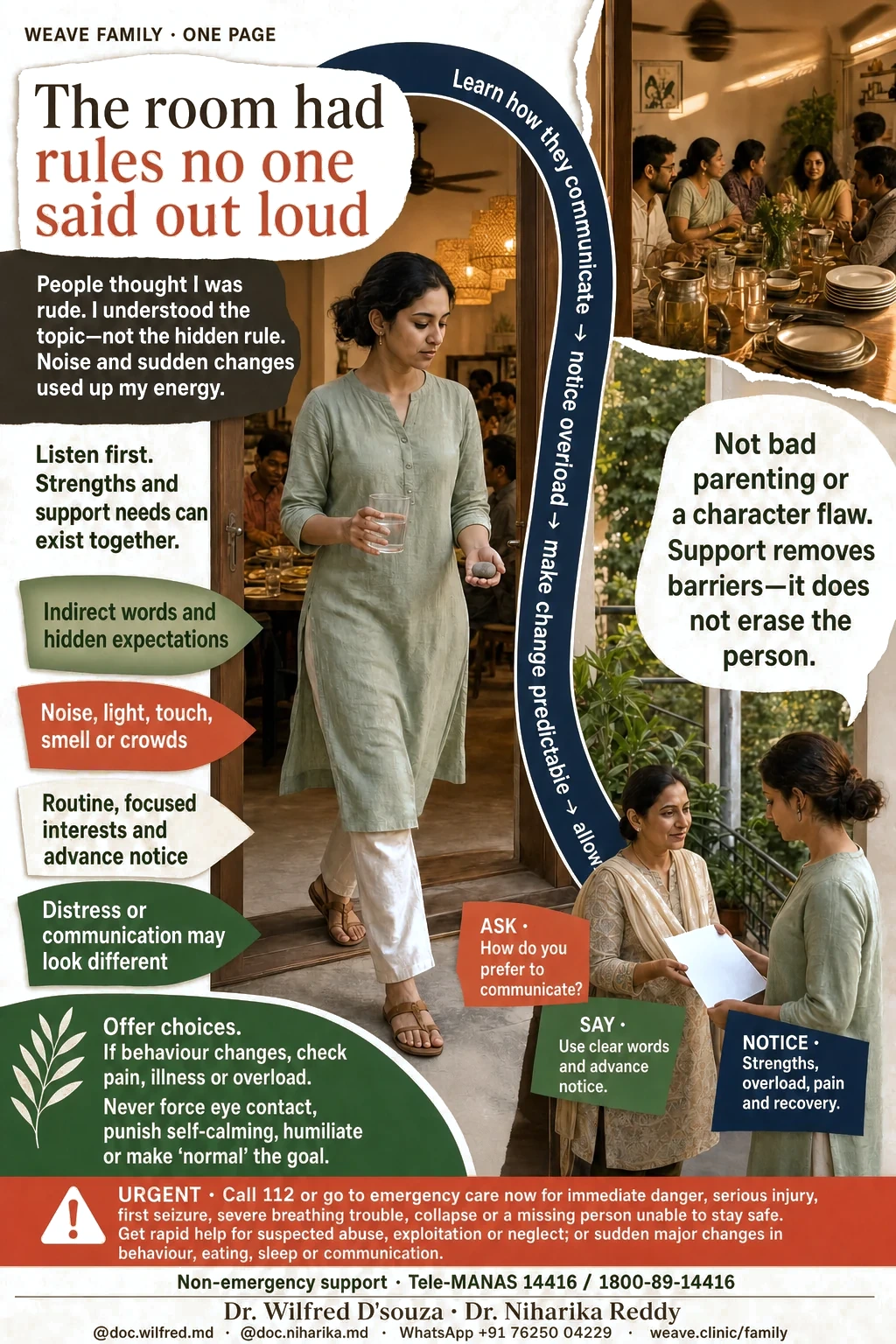
WEAVE FAMILY, ONE PAGE

The room had rules no one said out loud

Learn how they communicate, then notice overload, then make change predictable, then allow recovery.

'People thought I was rude. I understood the topic, not the hidden rule. Noise and sudden changes used up my energy.'

Listen first. Strengths and support needs can exist together.

Indirect words and hidden expectations. Noise, light, touch, smell or crowds. Routine, focused interests and advance notice. Distress or communication may look different.

Not bad parenting or a character flaw. Support removes barriers; it does not erase the person.

ASK: How do you prefer to communicate? SAY: Use clear words and advance notice. NOTICE: Strengths, overload, pain and recovery.

FAMILY: Offer choices. If behaviour changes, check pain, illness or overload. Never force eye contact, punish self-calming, humiliate or make 'normal' the goal.

URGENT: Call 112 or go to emergency care now for immediate danger, serious injury, first seizure, severe breathing trouble, collapse or a missing person unable to stay safe. Get rapid help for suspected abuse, exploitation or neglect; or sudden major changes in behaviour, eating, sleep or communication. Non-emergency support: Tele-MANAS 14416 / 1800-89-14416.

Dr. Wilfred D'souza, Dr. Niharika Reddy. weave.clinic/family
Neurodivergence

We stopped comparing and started asking

A good assessment finds needs, not a score.

Read as text

WEAVE FAMILY, ONE PAGE

We stopped comparing and started asking

She solved shapes her own way. She needed a better way to tell us what she needed.

A respectful assessment finds strengths, health needs and useful support, not just a score.

Communication is harder than expected. Movement, play, learning or self-care differ. Hearing, vision, sleep, feeding and seizures matter.

List strengths, then check health and communication, then set participation goals, then link home, school and care.

A good assessment does more than label. It finds needs and opens support.

WRITE: What they can do, what is hard, what helps. BRING: Hearing, sight, health and school information. ASK: Goals for communication, daily life and independence.

FAMILY: Follow interests. Use preferred communication. Notice useful gains. Never compare, punish, hide the person, force practice through distress or use unproven cures.

URGENT REVIEW: Lost language, movement or daily-living skill needs urgent child-health or neurology review. Call 112 or go to emergency care now for a first seizure; repeated seizures without recovery; sudden weakness; severe breathing trouble; collapse; or unusual unresponsiveness. Get rapid protection for abuse, neglect, serious injury or danger. Non-emergency support: Tele-MANAS 14416 / 1800-89-14416.

Dr. Wilfred D'souza, Dr. Niharika Reddy. weave.clinic/family

Sleep

The harder I chased sleep, the more awake I felt

Sleep follows rhythm, not willpower.

Read as text

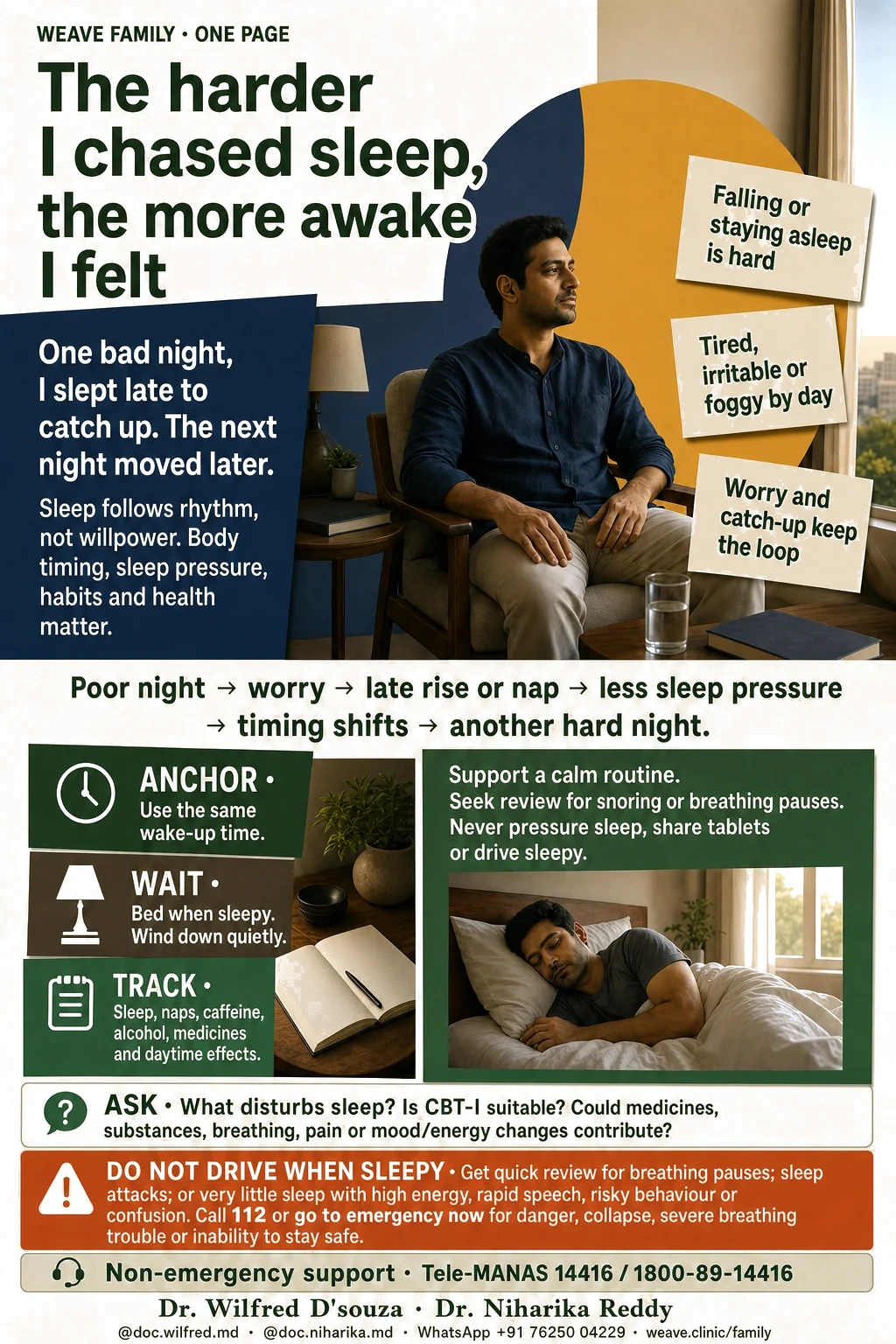
WEAVE FAMILY, ONE PAGE

The harder I chased sleep, the more awake I felt

One bad night, I slept late to catch up. The next night moved later.

Sleep follows rhythm, not willpower. Body timing, sleep pressure, habits and health matter.

Falling or staying asleep is hard. Tired, irritable or foggy by day. Worry and catch-up keep the loop.

Poor night, then worry, then late rise or nap, then less sleep pressure, then timing shifts, then another hard night.

ANCHOR: Use the same wake-up time. WAIT: Go to bed when sleepy. Wind down quietly. TRACK: Sleep, naps, caffeine, alcohol, medicines and daytime effects.

FAMILY: Support a calm routine. Seek review for snoring or breathing pauses. Never pressure sleep, share tablets or drive sleepy.

ASK: What disturbs sleep? Is CBT-I suitable? Could medicines, substances, breathing, pain or mood changes contribute?

DO NOT DRIVE WHEN SLEEPY: Get quick review for breathing pauses; sleep attacks; or very little sleep with high energy, rapid speech, risky behaviour or confusion. Call 112 or go to emergency now for danger, collapse, severe breathing trouble or inability to stay safe. Non-emergency support: Tele-MANAS 14416 / 1800-89-14416.

Dr. Wilfred D'souza, Dr. Niharika Reddy. weave.clinic/family
Memory

When memory starts to change

Write examples, not arguments.

Read as text

WEAVE FAMILY, ONE PAGE

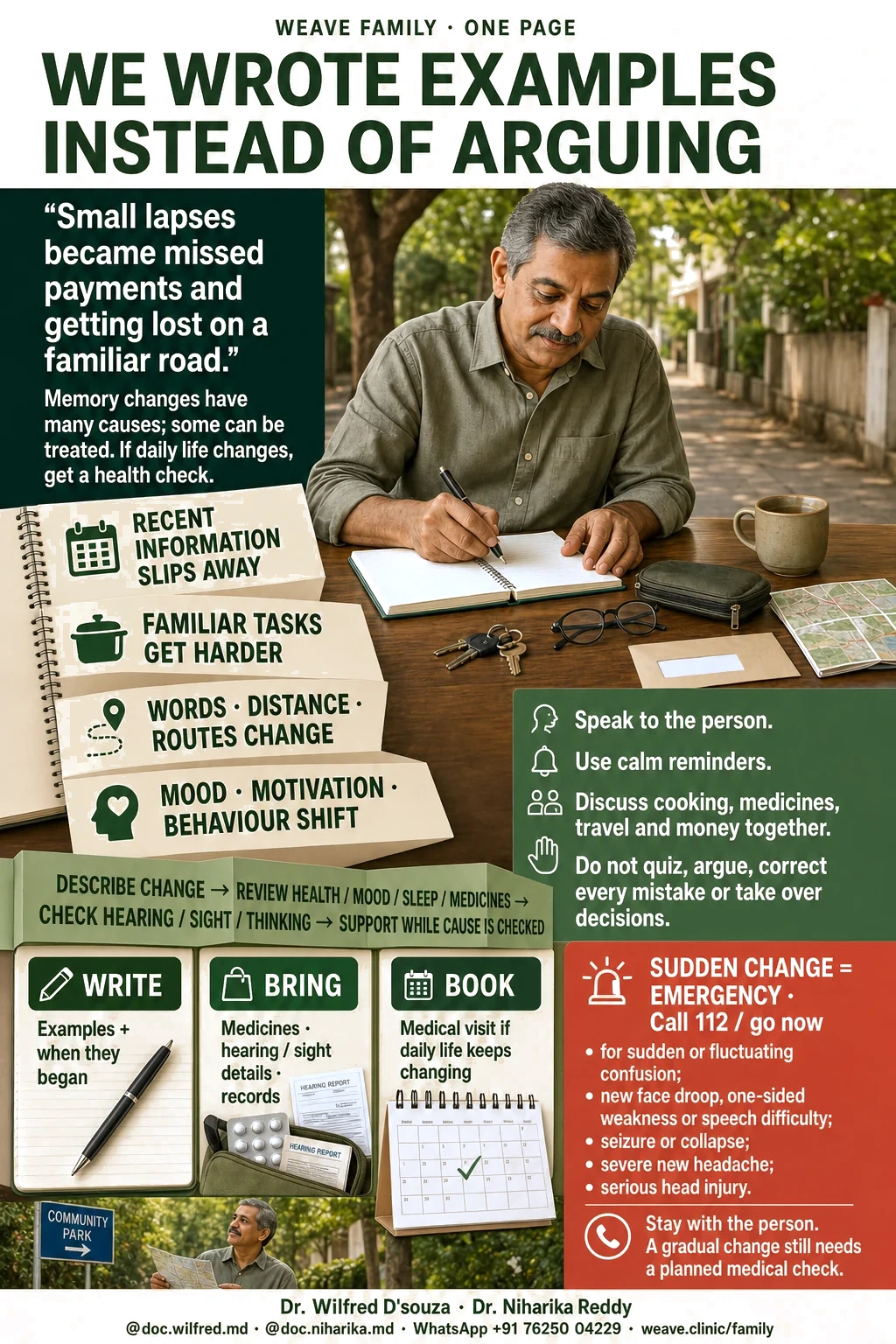
WE WROTE EXAMPLES INSTEAD OF ARGUING

'Small lapses became missed payments and getting lost on a familiar road.'

Memory changes have many causes; some can be treated. If daily life changes, get a health check.

RECENT INFORMATION SLIPS AWAY. FAMILIAR TASKS GET HARDER. WORDS, DISTANCE AND ROUTES CHANGE. MOOD, MOTIVATION AND BEHAVIOUR SHIFT.

DESCRIBE CHANGE, then REVIEW HEALTH, MOOD, SLEEP AND MEDICINES, then CHECK HEARING, SIGHT AND THINKING, then SUPPORT WHILE CAUSE IS CHECKED.

Speak to the person. Use calm reminders. Discuss cooking, medicines, travel and money together.

Do not quiz, argue, correct every mistake or take over decisions.

WRITE: Examples and when they began. BRING: Medicines, hearing and sight details, records. BOOK: Medical visit if daily life keeps changing.

SUDDEN CHANGE IS AN EMERGENCY. Call 112 or go now for sudden or fluctuating confusion; new face droop, one-sided weakness or speech difficulty; seizure or collapse; severe new headache; serious head injury.

Stay with the person. A gradual change still needs a planned medical check.

Dr. Wilfred D'souza, Dr. Niharika Reddy. weave.clinic/family
Want the whole thing?

Most of these have a longer, gentler book behind them, free to read and free to download.

Open the Family Library