The Family Guide
After the babySupporting a new mother
A warm, plain guide for the family around a new mother: how to see her, not only the baby, how to give support that truly helps, and how to spot when she needs a doctor, all without shame.
The fourth trimester and the new mother
The weeks right after a baby is born are a huge change for the mother, in her body, her sleep, and her feelings. If she is tired, tearful, or worried, that is common and human, not a sign of a weak or bad mother.
A baby arrives, and everyone looks at the baby. That is natural. But there is a second person who has just been through something enormous, and she needs looking at too. The mother's body is healing, her sleep is broken, her feelings are all over the place, and the whole shape of her days has changed overnight. People sometimes call these first weeks the fourth trimester, because in many ways the mother is still growing into her new life.
Low mood, tears for no clear reason, exhaustion, and worry in the weeks after birth are very common. In a large study that pooled data from more than twenty thousand Indian mothers, about one in five had low mood serious enough to be given a name by doctors. So a new mother who is struggling is far from alone, and she has done nothing wrong. A mother who is finding it hard is not a bad mother; she is a person who has just been through a great deal.
The family that understands this, and holds her gently through it, gives her the softest possible landing.
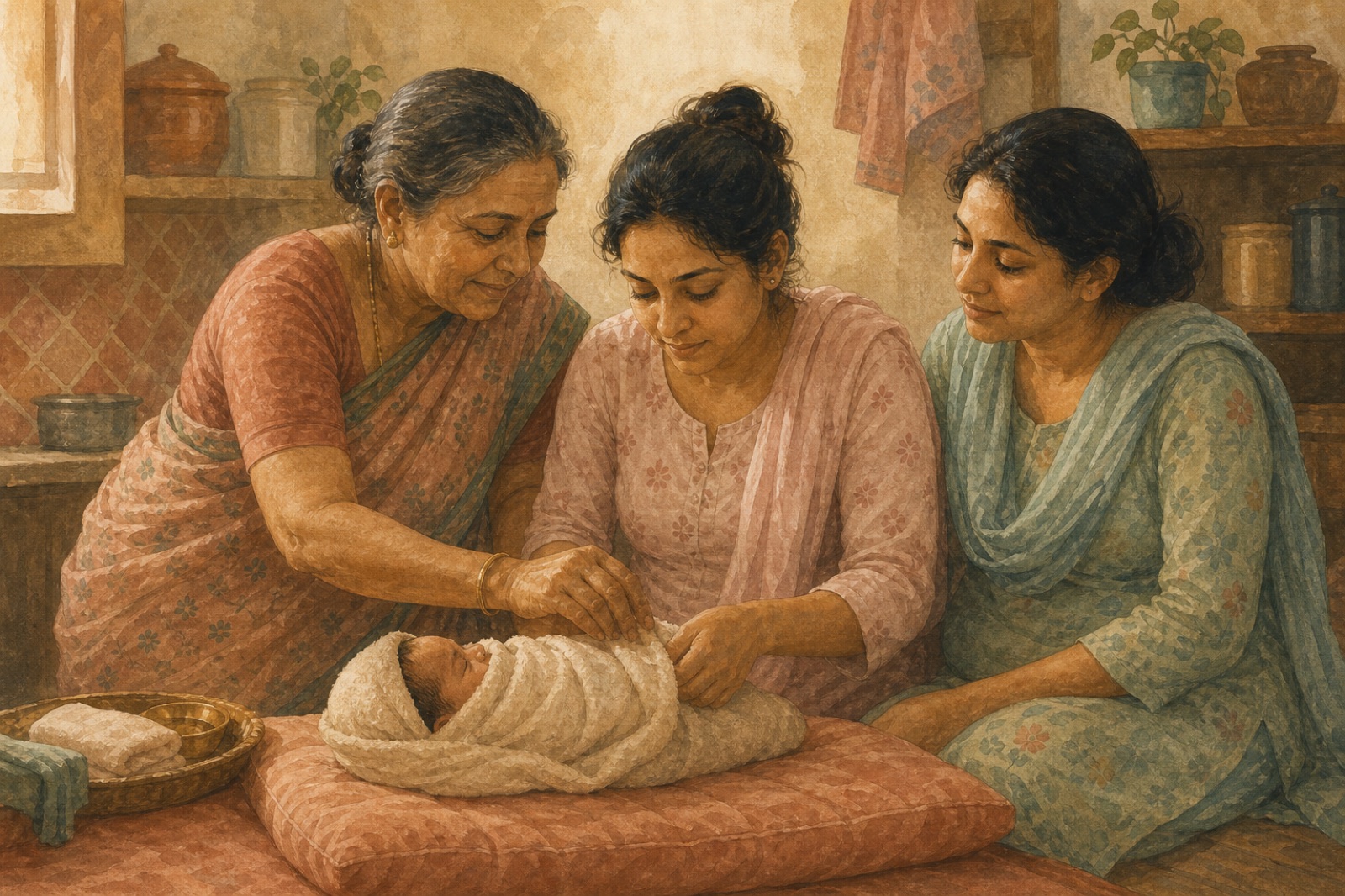
Meera has just had her first baby. Her mother-in-law and her own mother are both staying to help. The house is full of visitors, advice, and noise. Meera smiles for everyone, but at night she cries quietly and cannot sleep even when the baby sleeps. Nobody has done anything unkind. It is simply that all the attention has gone to the baby, and the tired, overwhelmed woman in the middle of it has slowly become invisible, even to herself.
She does not need anyone to fix her. She needs someone to notice her. The families who come through this well are the ones who remember, from the first day, that there are two people to care for in that room, not one.
For the next few days, before you pick up the baby, ask the mother one simple question first: "How are you feeling, and did you sleep?" Let her answer without rushing to advise. Being seen is itself a kind of care.
When help turns into pressure
Some of what families say and do, meaning well, quietly adds weight instead of taking it off. Comparison, taunts, and "in our time we managed" talk are the kind of pressure a family can simply choose not to add.
Most families want to help. But some of the most common things we say land as pressure, not support. "In our time we managed with nothing, and no drama." "Look how easily your cousin took to it." "What will people say if you cannot even handle one baby?" Each of these, even said lightly, tells a struggling woman that her struggle is a personal failing.
What surrounds a new mother truly matters for how she feels. In that same large Indian study, things like lack of support from the husband, conflict at home, and pressure or unkindness were linked to a mother developing low mood after birth, and an unwelcome reaction to a baby girl was a factor too. Comparison, taunts, and "in our time" talk add weight the family can choose not to add.
The "log kya kahenge" question is often loudest of all in these weeks. But a new mother's wellbeing is not a matter for the neighbours. It is a matter for the people in the room, and they can decide to protect her from that noise rather than pass it on.
Everyone kept telling me how their time was harder. I did not need a competition. I needed someone to sit with me.
A new mother
More, if you want it
Comparing one mother to another, or one baby to another, almost never helps and often stings. Every birth, every body, and every baby is different. A baby who feeds easily or sleeps well is not a sign of a better mother, and a baby who does not is not a sign of a worse one. When you feel a comparison rising, it is worth holding it back. Praise what she is doing rather than measuring her against someone else.
Notice the next "in our time" or comparison sentence before it leaves your mouth, and swap it for something on her side: "You are doing a hard thing, and you are doing it well." Watch how her shoulders drop when the pressure lifts instead of lands.
Support that actually helps
The support that helps most is warm and practical: good food, real rest, taking the baby so she can breathe, and not judging her. It helps her mood, not only her workload.
Support does not have to be grand. The most useful things are small and daily. Cook for her without being asked. Take the baby for a stretch so she can bathe, eat a hot meal, or simply sleep. Keep the house calm. And above all, do not judge, whether she is breastfeeding or not, crying or not, coping the way you would or not.
This kind of warm, practical support is not only kind, it genuinely helps her mood. A large review of ways to prevent low mood after birth found that the approaches built on gentle, person-centred listening, support from others, and involving the partner were among the most helpful, and mothers themselves valued having their partner involved and being able to talk things through with someone who truly cared. Warm, practical help changes how she feels, not just what she has to do.
So the food you cook and the hour of sleep you protect are doing more than easing her workload. They are steadying her heart.
- Cook and carry the meals, so she eats warm food and rests.
- Hold the baby for a stretch, so she can bathe or sleep.
- Listen without judging, and let the husband be involved.
- Keep the house calm, and shield her from taunts and comparison.
Two things deserve a special mention. First, the husband. It is easy in a joint home to leave the baby entirely to the women, but a father who is present, who holds the baby and asks the mother how she is, is one of the strongest supports she has. Second, listening. Sometimes the most healing thing is not advice at all, but someone who sits down, asks how she really is, and simply hears her out.
Remember
The question "what can I do to help?" is good. The action "let me take the baby while you sleep, I have got this" is better. A tired mother rarely has the energy to hand out tasks. Step in gently and take one thing off her plate without waiting to be asked.
Pick one practical thing this week and just do it, quietly and repeatedly: one hot meal a day, one guaranteed nap, one hour where the baby is yours and she is free. One reliable thing, done without fuss, is worth more than ten offers.
Spotting when she needs a doctor
Low mood in the first days is common and often passes. But when the heaviness, hopelessness, or frightening thoughts last more than about two weeks, that is the point to gently help her see a doctor.
Most new mothers have some low, weepy days, and these often lift on their own. What matters is when the low mood does not lift. If low mood, hopelessness, not sleeping even when the baby sleeps, not eating, pulling away from the baby, or frightening thoughts last more than about two weeks, that is the point to see a doctor. This is not about labelling her. It is about getting her the right help at the right time.
Getting help early is genuinely worth it. Left unattended, ongoing low mood after birth can affect the mother's own health, her bond with the baby, and even the baby's feeding, sleep, and early growth, which is exactly why acting sooner rather than later matters. Ongoing heaviness after birth is something a doctor can help with, and helping early is far kinder than waiting.
If she ever talks about not wanting to be here, or about harming herself or the baby, treat it as urgent. Do not argue or shame her. Stay with her, keep her and the baby safe, and reach a doctor or helpline the same day.
More, if you want it
It can be hard to tell ordinary tiredness from something that needs a doctor. A few gentle signs that it is worth seeking help: she has not smiled or felt any lift in a long stretch of days, she cannot sleep even when she has the chance, she has stopped eating or caring for herself, she seems frightened or far away, or she cannot feel any warmth toward the baby. None of these make her a bad mother. They are signs that a body and mind under strain need some support, just as they would for any other illness.
Agree together, as a family, on one simple line: "If the heavy feeling is still here in two weeks, we go to the doctor together, no shame, no fuss." Saying it out loud early makes it easy to act on later.
Protecting her sleep and space
Guarding a new mother's sleep is real medicine, not pampering. Taking the baby at night, keeping visitors and noise down, and letting her rest are among the most useful things a family can do.
In the rush of visitors and celebration, the one thing a new mother almost never gets is rest. Yet sleep may be the single most powerful support the family can protect. Taking the baby for a stretch at night so she can sleep, keeping the endless stream of guests short, and letting the house be quiet are not small courtesies. They are medicine.
This is not just a feeling. In a high-quality pooling of trials, helping new mothers get better sleep in the first year after birth actually lowered how severe their low-mood symptoms were. Protecting her sleep is real medicine, not pampering. So the family member who takes the 2am feed, or who politely tells visitors to come another day, is doing something genuinely powerful for her.
Space matters too. She needs a little room that is hers, a corner she can retreat to, permission to close a door. In a full joint home this takes some arranging, but it is worth it.
In her corner
Every guest who is turned away kindly, every hour of noise that is hushed, every night feed that someone else quietly takes, is a gift she may be too tired to ask for. You do not need her to request it. Protecting her rest is one of the most loving things the household can decide to do on its own.
This week, make a simple night plan so she gets one unbroken stretch of sleep: someone else takes the baby for those hours, and the phone and the doorbell go quiet. Protecting even one good sleep is worth more than a dozen kind words.
Getting help without shame
Reaching out for help is not a shame on the family. A family that treats getting help as ordinary care removes the single biggest thing standing in her way.
Here is the quiet truth about seeking help. What stops most new mothers is not the lack of doctors or medicine. It is shame, wrong ideas about what the low mood means, and feeling that no one is on their side. A review of what stops new mothers from reaching out found exactly this: stigma, misunderstanding, and feeling unsupported were the biggest barriers, while having people around who offered real support, and being met without judgement, made it far easier to ask for help. A family that treats help-seeking as ordinary care removes the single biggest obstacle in her way.
So the family is not just a bystander here. It is the deciding factor. When the people around her treat seeing a doctor for her mind as no different from seeing a doctor for a fever, the shame simply loses its grip.
None of this needs a diagnosis spoken over her, or any label the neighbours might hear. It needs a household that says, plainly and warmly, that getting support is a normal part of caring for a new mother, and that no one in this family will think less of her for it.
More, if you want it
There are simple, gentle ways to open the door. You might say, "Lots of mothers feel this way after a baby, and there are people who can help; shall we just talk to a doctor together?" Offer to go with her, so she does not have to face it alone. Keep it private and ordinary, not a family crisis meeting. And keep reminding her, in small ways, that asking for help is a sign of strength and love for her baby, never a failure.
Say one sentence to her this week that takes the shame out of it: "If you ever need to talk to someone, a doctor or a helpline, we will help you do it, and no one will think any less of you." Then mean it, quietly, every day after.
Where this comes from
Further reading
This guide helps you recognise and understand. It is not a diagnosis. For that, see a professional.